
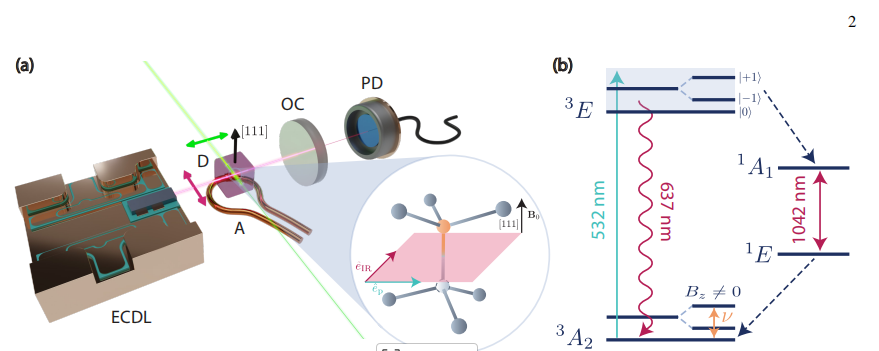
The article presents a novel magnetometry technique called Laser Intracavity Absorption Magnetometry (LICAM), which significantly improves the sensitivity of optical quantum sensors, particularly nitrogen-vacancy (NV) centers in diamond, under ambient conditions. LICAM enhances the measurement of magnetic fields by integrating intracavity absorption spectroscopy with laser threshold magnetometry, providing an innovative approach for high-sensitivity, compact, and power-efficient magnetometry.
LICAM Setup and Concept:
The LICAM sensor uses a self-sustained external-cavity diode laser (ECDL), which is electrically driven, to provide optical gain at 1042 nm.
NV− centers in diamond are used for sensing, with a 532 nm laser for optical pumping.
The laser system is designed to match the NV− singlet absorption line, and microwave radiation drives the NV− spin transitions for magnetic resonance detection.
Enhancement of Spin Contrast and Sensitivity:
Spin contrast shows a dramatic increase of 475-fold when the system operates near the lasing threshold.
The magnetic sensitivity improves by 180 times compared to conventional single-pass configurations. This enhancement is achieved both near and above the lasing threshold.
The LICAM technique also benefits from improved laser stability above threshold, which compensates for power fluctuations, contributing to a sharp increase in sensitivity.
Experimental Validation:
The LICAM performance is compared with conventional single-pass absorption magnetometry, where no significant spin contrast enhancement is observed.
The sensor operates at low power (5 µW), yet it achieves sensitivity on the nano- and femtotesla scales, which is much higher than typical conventional optical magnetometers operating at milliwatt power levels.
Simulation and Sensitivity Projections:
Using a rate-equation model, the study simulates and predicts that LICAM can achieve femtotesla-level sensitivity with realistic improvements.
Sensitivity is shown to scale with improved absorption constants, and the system's overall performance can be optimized within practical power constraints (with the diode laser operating at a maximum current of 200 mA).
Challenges and Future Directions:
While non-magnetic noise dominates the system near the lasing threshold, the paper suggests that further stabilization techniques and chip integration could mitigate this issue.
The concept of multi-mode LICAM is proposed as a next step, allowing for stable operation well above the lasing threshold, potentially enhancing the system’s robustness against power fluctuations.
LICAM represents a breakthrough in optical quantum sensing, enabling highly sensitive magnetometry in a compact and power-efficient system. The significant enhancement of spin contrast and magnetic sensitivity opens up new possibilities for applications in biomedical sensing (e.g., magnetoencephalography), material sciences, and other fields requiring precise magnetic field detection. The LICAM platform also offers scalability and integration potential, making it suitable for future on-chip quantum sensor technologies.
OMeda (Shanghai Omedasemi Co.,Ltd) was founded in 2021 by 3 doctors with more than 10 years of experience in nanpfabrication. It currently has 15 employees and has rich experience in nanofabrication (coating, lithography, etching, two-photon printing, bonding) and other processes. We support nanofabrication of 4/6/8-inch wafers.
