
This paper discusses the future of optical switching technologies, focusing on their potential applications in large-scale data center networks and machine learning supercomputers. The article examines device technologies for optical circuit switches (OCS), comparing various types of optical switches based on performance metrics such as insertion loss, crosstalk, port count, reconfiguration time, and polarization sensitivity.
Current Optical Switching Landscape:
Traditional large-scale data networks are built around electrical packet switches (EPS), which suffer from scaling limitations in terms of cost, latency, and reconfigurability. Optical circuit switches (OCS), by contrast, provide a dynamic, reconfigurable network topology, offering improved performance for applications like machine learning.
OCS technology allows the creation of end-to-end light paths, where all data packets travel the same route, reducing packet delay variations—this is particularly beneficial for synchronous workloads like those in AI systems.
Existing Optical Switch Technologies:
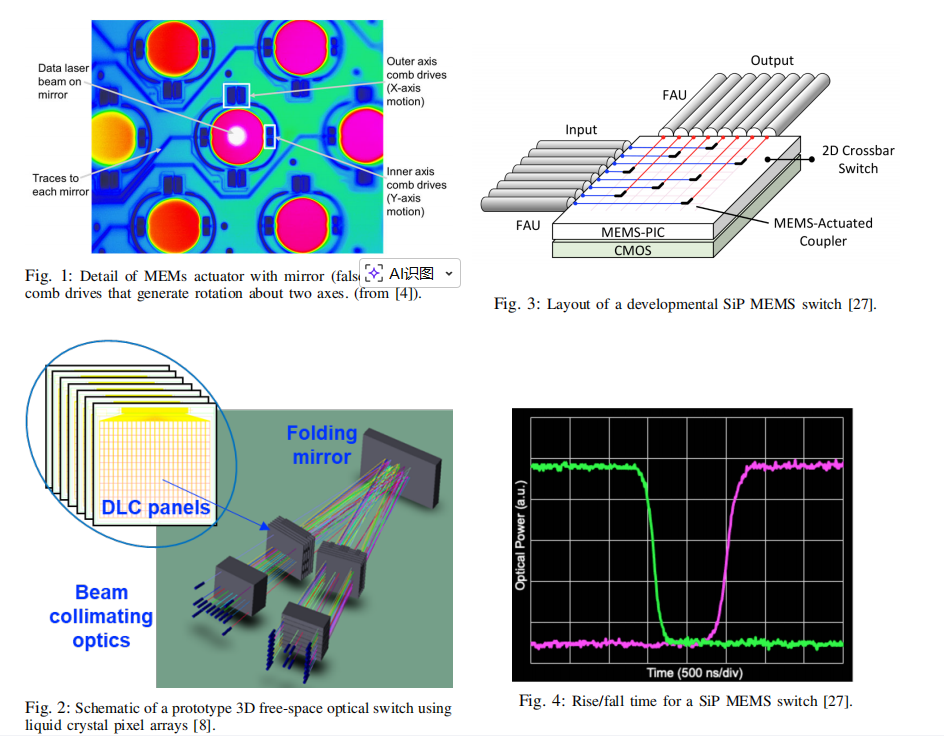
MEMS-based switches: MEMS (Micro-Electro-Mechanical Systems) switches use micro-mirrors controlled by high-voltage signals to create light paths. These are already in use for data center networks and machine learning systems, providing significant cost and performance benefits.
Free-space optical switches: These switches use 3D setups such as MEMS mirrors, piezo-electric devices, and liquid crystals to route light in free space. They offer high port counts and low insertion losses but come with challenges like high voltage requirements and slower switching speeds.
2D planar switches: These switches, often based on silicon photonics (SiP), use a grid of waveguides and rely on binary switches at the intersections to control light flow. These switches promise lower costs, faster switching, and better integration with electronic systems compared to 3D free-space switches, though challenges such as high fiber coupling losses and limited port counts persist.
Emerging Device Technologies:
Interference-based devices: Devices such as Mach-Zehnder interferometers and micro-ring resonators are used in planar 2D switches to control light propagation via interference effects. These devices are often slower (due to thermal tuning) and require complex control to avoid thermal crosstalk.
Heterogeneous integration: A promising approach for future switches involves combining silicon photonics with electro-optic materials to create fast, low-voltage switches. This integration could provide improvements in switching speed and device reliability.
MEMS for SiP 2D switches: MEMS actuated couplers can be used in planar SiP switches to direct light at waveguide crossings. These devices offer fast switching speeds and large port counts but still face challenges in minimizing fiber-waveguide coupling loss.
Wavelength Switching: This technology uses tunable lasers and passive waveguide components to switch at different wavelengths. However, wavelength switching tends to be power-hungry and expensive, with higher losses and fixed wavelength bands.
Performance Metrics:
The paper compares commercial 3D free-space switches and developmental 2D guided-wave switches. Commercial devices typically have a large port count (up to 576) and low loss but may have slower switching times. Developmental devices, especially those based on silicon photonics, aim to provide faster switching with lower insertion loss and voltage requirements, although challenges like fiber coupling and port count limitations still exist.
As optical circuit switching has been successfully implemented in commercial systems, ongoing research is focused on developing new device technologies that could further enhance the performance, scalability, and integration of optical switches for next-generation computing and networking systems. The future of optical switching will likely incorporate a mix of these technologies, with solutions tailored to specific use cases like data centers, machine learning systems, and potentially quantum computing.
The paper concludes that as these devices evolve, they will likely play a critical role in scaling and enhancing the performance of optical networks and supercomputing systems.
OMeda (Shanghai Omedasemi Co.,Ltd) was founded in 2021 by 3 doctors with more than 10 years of experience in nanpfabrication. It currently has 15 employees and has rich experience in nanofabrication (coating, lithography, etching, two-photon printing, bonding) and other processes. We support nanofabrication of 4/6/8-inch wafers.
