
The article titled "Transferable Polycrystalline Diamond Membranes for Solar-Blind Deep Ultraviolet Photodetectors" explores the development of polycrystalline diamond membranes (PCDm) as a promising material for high-performance solar-blind ultraviolet (UV) photodetectors. These devices are of particular interest for applications in extreme environments, as they can detect UV radiation below ≈280 nm, which is important for avoiding interference from sunlight. Here’s a summary of the key points:
Solar-blind UV photodetectors are vital for a variety of applications, including space-based communications, environmental monitoring, and chemical detection. These devices require materials that can block visible and infrared light, and wide bandgap semiconductors like diamond are ideal due to their ultra-wide bandgap (≈5.47 eV), excellent thermal conductivity, radiation resistance, and high carrier mobility. Polycrystalline diamond (PCD) films, grown by chemical vapor deposition (CVD), provide a cost-effective alternative to single-crystal diamond, offering scalability and flexibility. However, the grain boundaries in PCD can cause defects that affect device performance. The paper investigates how surface engineering of PCDm can enhance their photodetector performance.
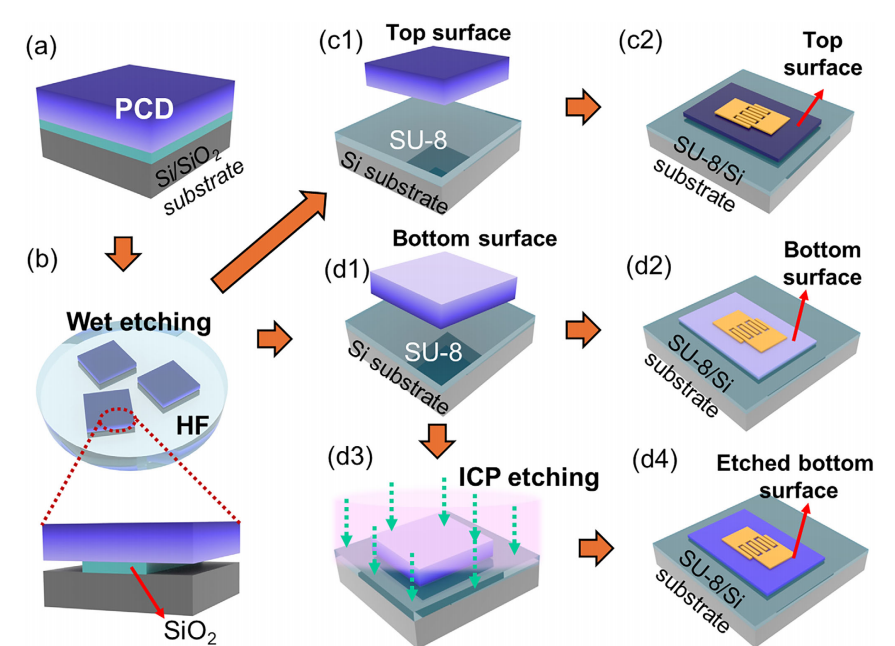
The fabrication of PCDm-based metal-semiconductor-metal (MSM) photodiodes involves three main surfaces of the polycrystalline diamond:
T-PCDm: The top surface, as grown, is rough and has large grain sizes.
B-PCDm: The bottom nucleation surface, which is smoother but has smaller grain sizes.
EB-PCDm: The etched bottom surface, where the nucleation layer is removed via plasma etching to create a smoother, more uniform surface.
These three surfaces are used to fabricate photodiodes and their surface properties are analyzed for their effect on the optoelectronic performance of the photodetectors.
The surface morphology of the PCDm was studied using scanning electron microscopy (SEM), showing distinct differences between the surfaces. The T-PCDm surface had larger grains and a rougher morphology, whereas the B-PCDm surface was smoother with smaller grains. The EB-PCDm surface exhibited an intermediate grain size after etching, with improved smoothness compared to the bottom nucleation surface.
Raman spectroscopy was used to analyze the chemical composition of the surfaces, revealing varying ratios of sp2 (graphitic) and sp3 (diamond) bonding. T-PCDm had the lowest sp2 content, indicating a higher proportion of diamond, while B-PCDm had a higher sp2 fraction, suggesting increased defects and non-diamond carbon content. EB-PCDm exhibited reduced sp2 content following the etching process, improving its chemical purity.
The photodetectors fabricated on different PCDm surfaces showed distinct optoelectronic behaviors:
T-PCDm: Exhibited the highest responsivity (0.55 A/W at 265 nm), highest detectivity (≈1.4 × 10¹² Jones), and a large on/off ratio (650). This superior performance is attributed to its larger grain size, rougher morphology, and reduced sp2 content, which enhances light trapping and carrier transport. However, it showed slower temporal response.
B-PCDm: Demonstrated lower responsivity and photocurrent, with smaller grains and higher sp2 content, which reduced carrier generation and transport efficiency.
EB-PCDm: Showed moderate performance, with improved responsivity and faster temporal response compared to B-PCDm, thanks to the smoother surface and reduced sp2 content from the etching process.
Time response measurements showed that T-PCDm had the slowest rise time (2.71 seconds), while EB-PCDm had the fastest (0.11 seconds). The improved response of EB-PCDm was attributed to reduced trap states and enhanced carrier mobility.
Flexible devices were fabricated on polyimide substrates using T-PCDm and EB-PCDm. These devices showed stable responsivity under mechanical strain, with only minor changes in performance under bending. T-PCDm maintained a stable responsivity of 0.42 A/W at 265 nm, while EB-PCDm showed consistent performance of 0.006 A/W at 255 nm, even under tensile and compressive strains. These results demonstrate the mechanical robustness and flexibility of PCDm, making them suitable for flexible optoelectronic applications.
This study highlights the importance of surface engineering in optimizing the performance of PCDm-based solar-blind UV photodetectors. The T-PCDm devices exhibited the highest responsivity and detectivity, while EB-PCDm provided a balanced performance with faster response times. The flexibility and mechanical robustness of PCDm also make it a promising material for flexible and radiation-resistant UV photodetectors. The findings suggest that polycrystalline diamond membranes are a versatile platform for high-performance optoelectronic devices, with potential applications in harsh environments.
OMeda (Shanghai Omedasemi Co.,Ltd) was founded in 2021 by 3 doctors with more than 10 years of experience in nanpfabrication. It currently has 15 employees and has rich experience in nanofabrication (coating, lithography, etching, two-photon printing, bonding) and other processes. We support nanofabrication of 4/6/8-inch wafers.
