
This article discusses the integration of solution-processed BaTiO₃ thin films with high Pockels coefficients on photonic integrated circuits (PICs), aiming to address the limitations of current integration techniques for ferroelectric thin films. The authors propose using a La₂O₂CO₃ template film combined with chemical solution deposition (CSD) for the scalable, high-throughput integration of BaTiO₃ films, which significantly enhances their potential for use in high-speed photonic modulators.
Key points from the study include:
Alternative Integration Process: The article highlights the use of a La₂O₂CO₃ template film and CSD for integrating BaTiO₃ thin films on PIC platforms. This method offers several advantages over conventional high-vacuum techniques, such as lower cost, higher throughput, and greater flexibility in integration, particularly on substrates that cannot withstand high temperatures.
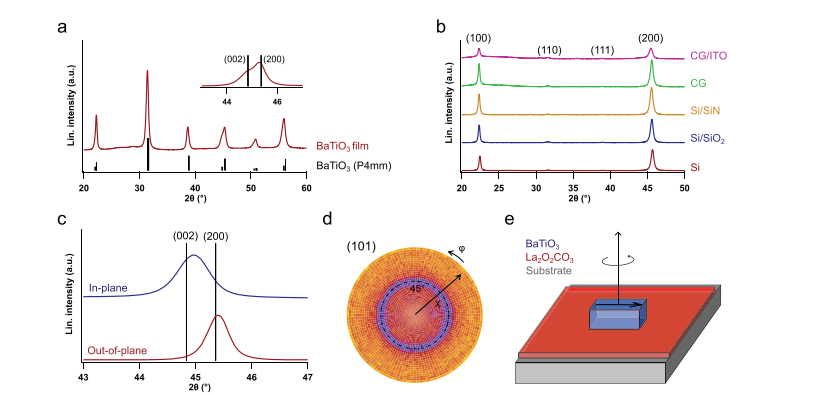
Material Properties: The BaTiO₃ film exhibits a tetragonal crystal structure (P4mm) with a preferential a-axis orientation, ensuring strong electro-optic (EO) properties. The film's texture, combined with its random in-plane polarization orientation, ensures a robust EO response that is independent of electrode alignment.
Pockels Coefficient: The BaTiO₃ thin film shows a large Pockels coefficient (reff = 139 pm/V), which is critical for high-performance modulators. This value is comparable to those obtained from state-of-the-art BaTiO₃ films produced by molecular beam epitaxy (MBE) with SrTiO₃ template films, confirming the effectiveness of the solution-based method.
Device Integration and Performance: The BaTiO₃ film was integrated into a silicon nitride (SiN) ring resonator to evaluate its modulating capabilities. The results show that the integrated BaTiO₃ film operates as an electro-optic modulator with a half-wave voltage-length product (VπL) of 1.881 V·cm and an electro-optic bandwidth of 43 GHz. The modulator's performance, including a high-speed modulation capability, confirms the viability of the BaTiO₃ thin film for future high-speed photonic devices.
Long-Term Stability: The electro-optic response of the BaTiO₃ film remains stable over time, demonstrating low hysteresis and a stable remnant Pockels coefficient, which is crucial for reliable device operation.
In conclusion, the work provides a scalable, cost-effective method for integrating high-quality BaTiO₃ thin films onto photonic platforms, offering significant potential for large-scale fabrication of high-speed nanophotonic modulators. This solution process could play a pivotal role in advancing the integration of ferroelectric thin films into next-generation optical communication systems and other photonic applications.
OMeda (Shanghai Omedasemi Co.,Ltd) was founded in 2021 by 3 doctors with more than 10 years of experience in nanpfabrication. It currently has 15 employees and has rich experience in nanofabrication (coating, lithography, etching, two-photon printing, bonding) and other processes. We support nanofabrication of 4/6/8-inch wafers.
