
This article presents a novel method for integrating ferroelectric thin films, specifically BaTiO₃, directly onto photonic integrated circuits (PICs), highlighting its potential for high-speed nanophotonic modulators. Ferroelectric materials like BaTiO₃ are known for their strong electro-optic (EO) properties, which are essential for enabling fast and efficient phase modulation in optical devices. The integration of these films into PICs has historically been challenging due to the need for complicated techniques like wafer bonding and transfer printing.
Key points from the study include:
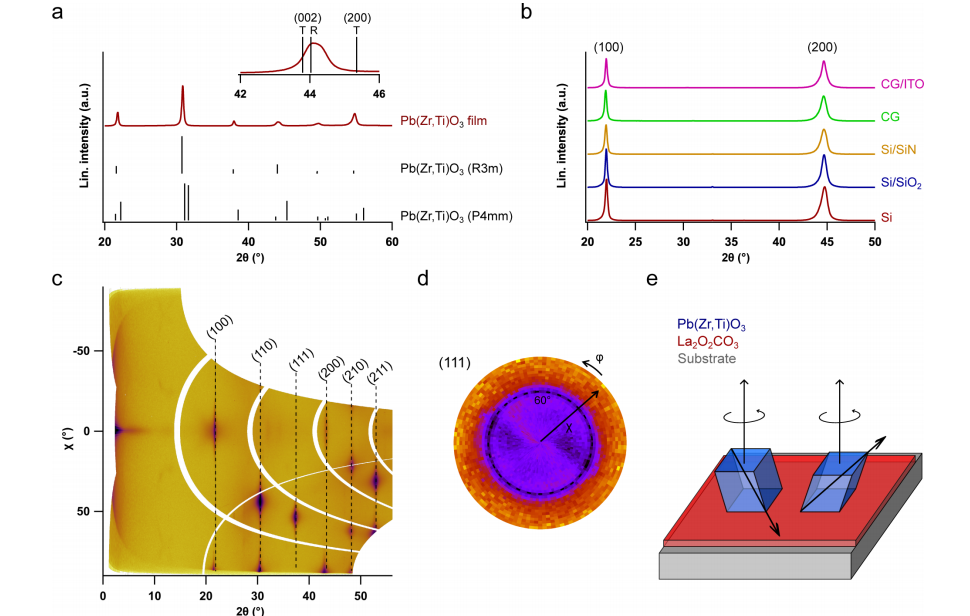
Novel Integration Method: The authors propose using a chemical solution deposition (CSD) process to directly integrate BaTiO₃ thin films on silicon photonic platforms, eliminating the need for transferring the films from another substrate. A La₂O₂CO₃ template film is used to facilitate the deposition, ensuring compatibility with silicon waveguides.
Fabrication Process: The process involves starting with a 220 nm silicon-on-insulator (SOI) substrate, followed by electron beam lithography for patterning the photonic circuit. A plasma etching method is then used to create waveguides, which are planarized with hydrogen silsesquioxane (HSQ). After the deposition of an 8 nm La₂O₂CO₃ seed film and a 120 nm BaTiO₃ film, metal electrodes are applied for electrical contact.
Experimental Results: The authors test the integration by fabricating a BaTiO₃-based C-band ring resonator on a silicon photonic chip. Using light at 1550 nm, the resonance wavelength of the ring is shifted under different applied voltages, showing a shift in resonance that correlates with changes in the applied electric field, demonstrating the electro-optic effect. This provides a half-wave voltage-length product (VπL) of 2.638 V·cm and a Pockels coefficient (rwg) of 155.57 pm/V, which are comparable to those of high-quality BaTiO₃ films in previous reports.
Potential for Future Use: The results confirm that the BaTiO₃ films have an excellent EO response, making them suitable for use in advanced optical modulators for telecommunications and other applications. The direct integration method using CSD and the La₂O₂CO₃ template film opens up opportunities for cost-effective, scalable integration of high-performance ferroelectric materials in silicon photonics.
In conclusion, this work introduces an efficient and scalable method for integrating BaTiO₃ thin films into silicon photonic platforms, providing a pathway for the development of next-generation high-speed photonic modulators. The promising electro-optic properties of these films could enhance the performance of future nanophotonic devices.
OMeda (Shanghai Omedasemi Co.,Ltd) was founded in 2021 by 3 doctors with more than 10 years of experience in nanpfabrication. It currently has 15 employees and has rich experience in nanofabrication (coating, lithography, etching, two-photon printing, bonding) and other processes. We support nanofabrication of 4/6/8-inch wafers.
