
This article explores the spectral stability and optical coherence of single-photon emitters, specifically erbium-doped silicon (Er:Si), integrated into Fabry-Perot resonators for quantum applications. The key objective is to reduce the spectral diffusion and improve optical coherence times, crucial for efficient spin-photon interfaces in quantum information processing.
Key Points:
Spectral Stability:
The study investigates how integrating erbium-doped silicon into Fabry-Perot resonators improves the spectral stability of single emitters, especially in comparison to nanophotonic devices.
By increasing the emitter distance from the silicon surface (via the Fabry-Perot setup), the authors significantly reduce spectral instability caused by surface interactions and charge noise.
The work reports a fivefold reduction in the spectral diffusion linewidth, down to 4 MHz, improving the stability of individual emitters in silicon, a critical factor for their use in quantum networks.
Improved Optical Coherence:
The authors observe a tenfold increase in optical coherence times, with values up to 20 microseconds, in comparison to prior experiments using nanophotonic devices. This enhancement is due to the reduced emitter concentration (lower dopant density), which minimizes interactions that degrade coherence.
By applying laser-induced spectral diffusion measurements, the study shows that the coherence time decreases with the intensity of optical pulses, confirming the influence of laser-induced spectral fluctuations.
Experimental Setup:
The erbium-doped silicon membrane (2 µm thick) was integrated into a high-finesse optical Fabry-Perot resonator, with the device designed to tune the cavity resonance using a piezo tube for precise control.
The devices were characterized at room and cryogenic temperatures, using photon-echo measurements to determine optical coherence and spectral stability.
Analysis of Noise Sources:
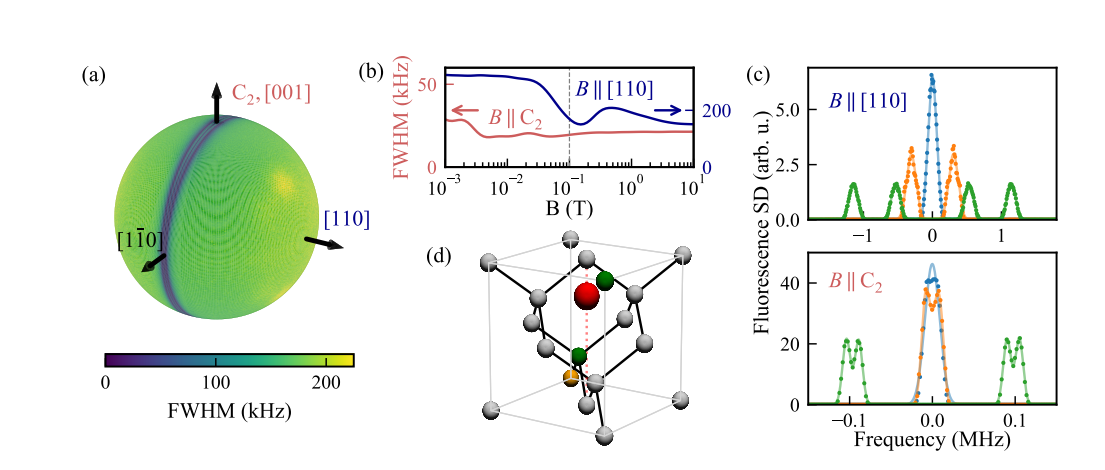
The research identifies the sources of spectral instability, including charge fluctuations and nuclear spin-induced noise. Using isotopically purified silicon (28Si) to reduce nuclear spin noise led to further improvements in spectral stability, though residual instability remained due to electric field noise.
The study also points out that the electric field fluctuations (due to charge traps in the bulk material) are the dominant cause of spectral instability.
Future Directions:
Further improvements could be made by using even lower dopant concentrations or by exploring other techniques to enhance spectral stability.
The study envisions using these high-quality Fabry-Perot resonators for quantum networking, where frequency multiplexing of spin qubits could be achieved, potentially scaling up the number of qubits in quantum processors.
Conclusion:
This work represents a significant advancement in the quest for spectrally stable spin-photon interfaces in silicon, with improvements in both spectral diffusion and optical coherence times. These findings are pivotal for building efficient quantum networks and distributed quantum information systems, moving toward practical, scalable quantum technologies.
