
This article discusses advancements in the frequency stability of optical cavities, focusing on the use of crystalline AlGaAs coatings in cryogenic silicon cavities for high-performance optical clocks. These developments are crucial for applications in precision measurement, optical atomic clocks, and potentially for next-generation gravitational wave detectors.
Key Highlights:
Crystalline Coatings Over Dielectric Mirrors:
The research demonstrates the clear advantage of using crystalline AlGaAs coatings over conventional dielectric mirrors in cryogenic silicon cavities. The authors achieved a remarkable fractional frequency stability of 2.5 \times 10^{-17}2.5×10⁻¹⁷ at 10 seconds, which is four times better than the expected thermal noise limit of conventional dielectric coatings.
This improvement corresponds to a more than tenfold reduction in the mechanical loss factor of the coatings, confirming the superior performance of crystalline AlGaAs coatings at cryogenic temperatures.
Cryogenic Silicon Cavities:
The cavity setup includes a 6-cm-long silicon cavity with crystalline mirrors, cooled to 17 K. The cavity design features a high finesse of 470,000 at an operating wavelength of 1542 nm, and the mirrors are made from alternating layers of GaAs and AlGaAs.
The authors effectively mitigate vibration noise from the cryostat using a split-plate design and active vibration isolation. Residual amplitude modulation (RAM) is minimized with a specialized scheme, achieving shot noise-limited operation with very low cavity transmission.
Optical Frequency Averaging:
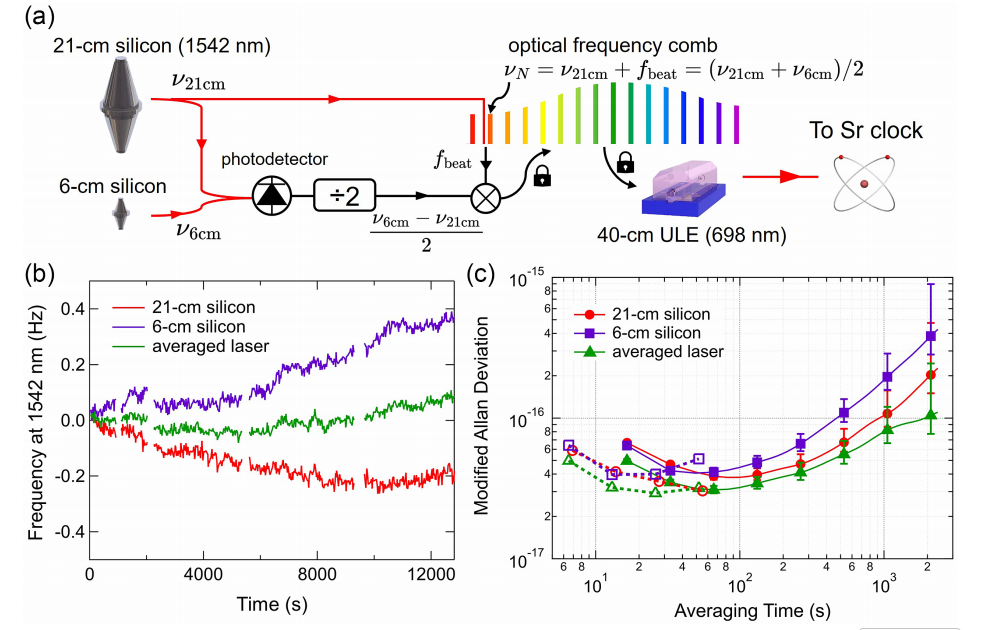
The team also demonstrates optical frequency averaging using two state-of-the-art silicon cavities. This approach improves the laser stability by averaging the frequencies of the two cavities, reducing both short and long-term instability.
The modified Allan deviation of the averaged laser is more stable than the individual lasers by approximately a factor of \sqrt{2}, consistent with expectations. The laser's stability is limited at short times by Dick noise, which can be reduced by reducing the dead time in measurements.
Long-Term Drift Rates of Silicon Cavities:
The article includes a study of the long-term drift rates of four cryogenic silicon cavities, measured over more than ten years at PTB and JILA. These cavities exhibit very low drift rates compared to typical ultralow-expansion (ULE) glass cavities, with drift rates in the range of a few microhertz per second.
The drift behavior of the 6-cm cavity (Si6) differs from the other cavities, settling to a low drift rate much faster than the 21-cm cavities, suggesting that factors like the cavity length and temperature crossing points affect the drift characteristics.
Future Prospects:
The results suggest that with further improvements in mirror coatings and cavity designs, it is possible to achieve fractional frequency stability on the order of 10^{-18}10−18, with a corresponding reduction in drift rates, making it feasible to develop optical cavities for highly stable optical timescales.
These advancements open up new possibilities for using cryogenic silicon cavities in optical clocks and precision measurements that require ultra-low noise and long-term stability.
Conclusion:
The integration of crystalline AlGaAs coatings into cryogenic silicon cavities has significantly improved the frequency stability, pushing the limits of precision metrology. This work sets the stage for the development of optical clocks with fractional stabilities approaching 10^{-18}10−18, potentially leading to the creation of optical timescales for highly accurate measurements in fundamental physics and precision timekeeping.
