
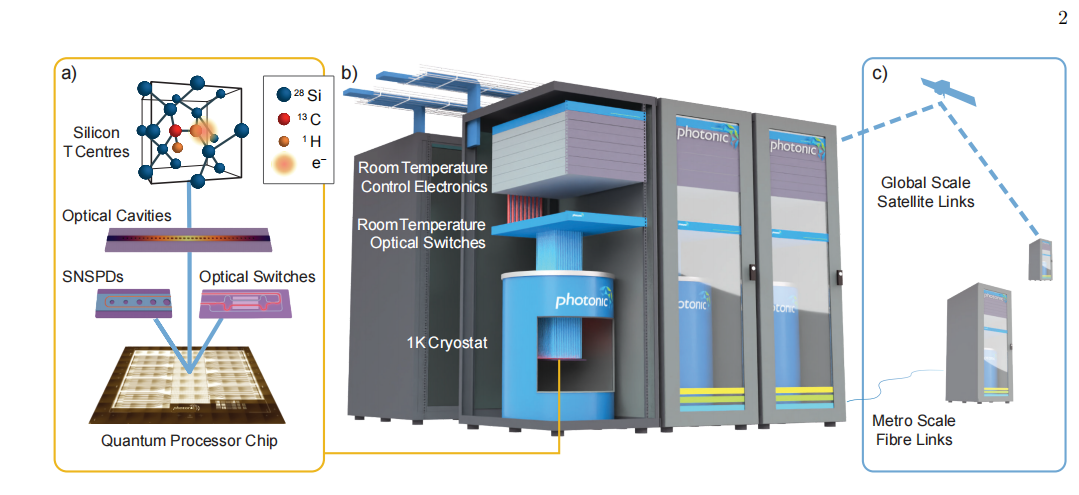
The article presents a vision for scalable quantum technologies, focusing on the integration of quantum computing and quantum networking. It proposes an architecture that uses silicon-based spin qubits, particularly the T centre spin-photon interface, to create a modular and horizontally scalable system. This architecture addresses the current challenges in quantum technologies, particularly the difficulties in distributing high-quality entanglement at scale, by leveraging telecom photons for photonic links and integrating quantum processors with quantum repeaters.
Key points discussed include:
Scalable Quantum Networking and Computing: The proposed architecture uses a high-connectivity system, where quantum repeaters and quantum processors are connected through telecom photons. This setup enables horizontal scaling, allowing for the creation of large, modular quantum networks and processors.
Silicon T Centres: The T centre spin-qubit system in silicon offers a strong spin-photon interface, high fidelity, long-lived spin memories, and compatibility with integrated photonics. These qualities make it ideal for building scalable quantum computing and networking systems.
Modular Quantum Processing: The architecture emphasizes modularity, allowing quantum processors to be linked via telecom photons. This modularity enables more efficient entanglement distribution and scaling of quantum resources.
Quantum Error Correction (QEC): The architecture supports low-overhead quantum error correction codes, such as Quantum Low-Density Parity-Check (QLDPC) codes, which are crucial for achieving fault tolerance at scale.
Quantum Networking Applications: The paper highlights the use of this architecture for several quantum networking applications, including Memory-Assisted Measurement-Device-Independent Quantum Key Distribution (MA-MDI QKD) and blind quantum computing. Both applications benefit from the high-connectivity entanglement distribution and the ability to handle photon loss and quantum errors effectively.
Quantum Repeaters: Quantum repeaters, which are essential for long-distance quantum communication, are integrated into the system. These repeaters use T centre processors to create and distribute entanglement over large distances, facilitating the development of a global quantum network.
In conclusion, the article presents a scalable and robust architecture for quantum networking and computing that can be implemented using silicon T centres. It leverages high-connectivity, modular systems to overcome current scaling challenges, offering a promising route to large-scale, fault-tolerant quantum technologies.
OMeda (Shanghai Omedasemi Co.,Ltd) was founded in 2021 by 3 doctors with more than 10 years of experience in nanpfabrication. It currently has 15 employees and has rich experience in nanofabrication (coating, lithography, etching, two-photon printing, bonding) and other processes. We support nanofabrication of 4/6/8-inch wafers.
