
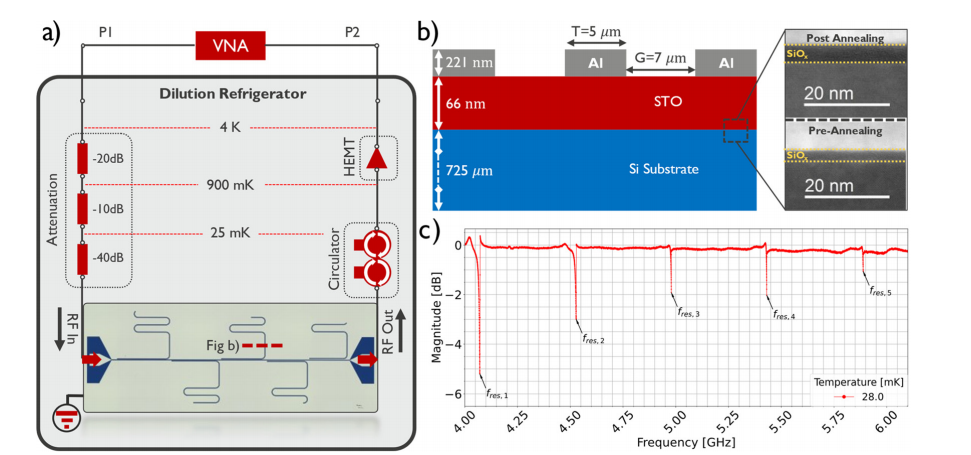
The article discusses the microwave permittivity and loss characteristics of epitaxial SrTiO3 films grown on silicon (Si) substrates at cryogenic temperatures. SrTiO3 is a material with extremely high permittivity, making it a promising candidate for advanced microwave-optical devices, particularly in quantum technology.
Key points from the study:
Materials and Methods: The study used superconducting Al coplanar waveguide resonators in the frequency range of 4 to 6 GHz to measure the complex permittivity and loss of SrTiO3 thin films on Si at temperatures as low as 25 mK. The films had a measured permittivity of 1950 ± 140 and a high-power loss tangent (tan δSTO) of 3.4 ± 0.1 × 10⁻⁴, representing an improvement by factors of 2 and 30, respectively, over previously reported values.
Two-Level System Mechanism: The study observed a nearly two-order-of-magnitude difference in loss at low and high input powers, consistent with a two-level system (TLS) loss mechanism, which is relevant for the single-photon regime in quantum technologies.
Characterization and Results: The measurements were conducted using advanced techniques, including resonator-based methods to extract the permittivity and loss data. The permittivity of SrTiO3 on Si was estimated using effective medium theories, showing that over 70% of the energy is confined within the SrTiO3 film.
Loss Mechanisms: The study also explores the origins of losses in the SrTiO3 films, attributing some of them to defects, oxygen vacancies, and the two-level systems. The intrinsic loss tangent due to these two-level systems was found to be 9.2 × 10⁻³, which is comparable to typical TLS losses in other materials. However, power-independent losses attributed to the SrTiO3 film were significantly lower, highlighting its potential for low-loss applications at cryogenic temperatures.
Conclusion: The study concludes that SrTiO3 on Si shows significant improvements in both permittivity and loss compared to previous works, making it a promising material for future quantum and microwave-optical devices. Further research is needed to understand and reduce the sources of TLS losses to improve performance, particularly at low power regimes.
This research contributes to the development of high-capacitance devices and the potential use of SrTiO3 in quantum technology, where low loss and high permittivity are critical for improving the performance of devices like quantum transducers and phase shifters.
OMeda (Shanghai Omedasemi Co.,Ltd) was founded in 2021 by 3 doctors with more than 10 years of experience in nanpfabrication. It currently has 15 employees and has rich experience in nanofabrication (coating, lithography, etching, two-photon printing, bonding) and other processes. We support nanofabrication of 4/6/8-inch wafers.
