
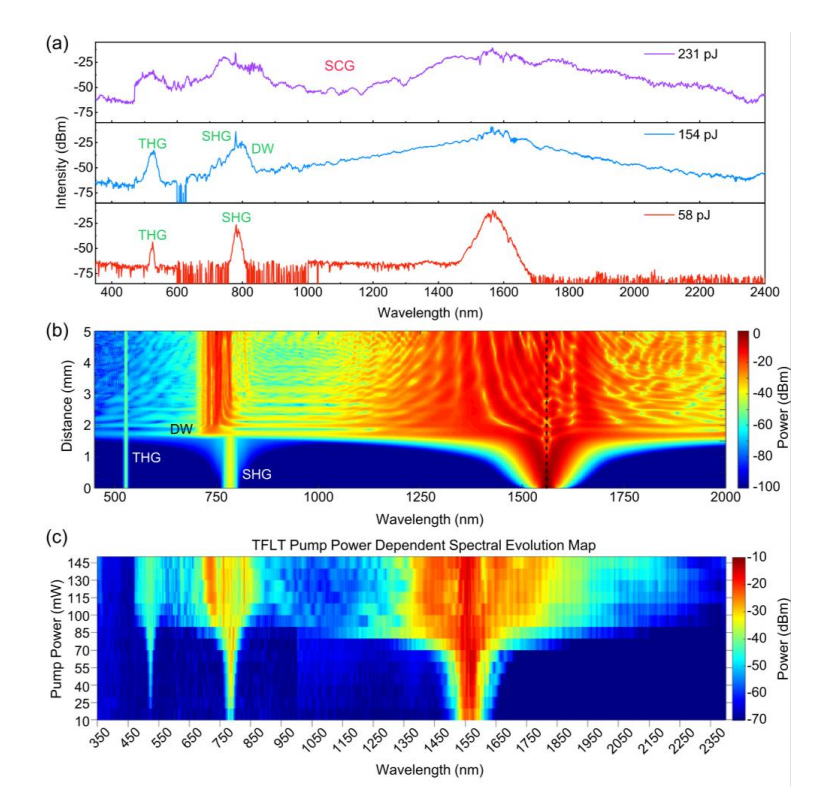
The article discusses the first demonstration of supercontinuum generation (SCG) over three octaves (from 240 nm to over 2400 nm) in thin-film lithium tantalate (TFLT) waveguides. Here are the key findings and contributions:
Supercontinuum Generation in TFLT: This study reports the generation of an ultrabroad spectrum spanning ultraviolet (UV), visible, and near-infrared (NIR) wavelengths. The spectrum was achieved using a 1560 nm pump in a dispersion-engineered, straight TFLT waveguide. The process transitions from harmonic generation (second- and third-harmonics) to a broadband continuum driven by soliton fission and dispersive wave emission.
Waveguide Design and Fabrication: The waveguides were fabricated from a 600 nm-thick z-cut TFLT-on-insulator wafer. The design utilized electron-beam lithography and inductively coupled plasma reactive ion etching, yielding ridge waveguides with varying widths from 0.45 µm to 1.65 µm. Dispersion engineering was crucial, particularly at the 1560 nm pump wavelength, where the waveguide exhibits anomalous group-velocity dispersion.
Spectral Evolution: Experimental measurements show a clear spectral evolution with increasing pump power, beginning with phase-matched second-harmonic generation (SHG) and third-harmonic generation (THG). As the pulse energy increases, dispersive waves emerge and eventually coalesce into a broad supercontinuum that spans from the UV to the NIR.
Polarization and Geometry Dependence: The study systematically varied the input polarization and waveguide geometry, finding that efficient SCG with strong dispersive waves and harmonic features was observed primarily under TE polarization. Narrower waveguides favored different phase-matching conditions for SHG and THG, and the dispersion and geometry of the waveguides played a significant role in tuning the generated spectrum.
Numerical Simulations: The experimental results were validated using Generalized Nonlinear Schrödinger Equation (GNLSE) simulations, which accurately modeled the spectral evolution from harmonic generation to broadband continuum formation. These simulations helped confirm the phase-matching conditions for dispersive wave generation and the observed wavelength shifts with waveguide width.
Applications and Future Potential: This work positions TFLT waveguides as a promising platform for integrated photonics, particularly for on-chip frequency metrology, broadband sensing, and quantum light sources. TFLT's high nonlinear efficiency, low loss, and broad transparency window make it a competitive material for creating advanced photonic devices.
In conclusion, this study demonstrates the potential of TFLT waveguides for ultrabroadband supercontinuum generation, paving the way for new applications in nonlinear photonics and integrated optical systems.
OMeda (Shanghai Omedasemi Co.,Ltd) was founded in 2021 by 3 doctors with more than 10 years of experience in nanpfabrication. It currently has 15 employees and has rich experience in nanofabrication (coating, lithography, etching, two-photon printing, bonding) and other processes. We support nanofabrication of 4/6/8-inch wafers.
