
The article discusses the Silicon T centre as a promising spin-photon interface (SPI) for quantum networks, emphasizing the integration of communication and memory qubits. Here are the key insights:
Spin-Photon Interfaces (SPIs): SPIs combine the long coherence times of spin qubits with the ability to transmit quantum information via photons. This makes them ideal for quantum communication and computation. In SPIs, memory qubits (spin-based) and communication qubits (photon-based) work together, and efficient operation of memory qubits is crucial for high fidelity in remote entanglement and other quantum tasks.
T Centre in Silicon: The T centre in silicon is a multi-atom defect that emits in the telecommunications O-band (around 1326 nm), integrating well with silicon photonics. It features both electron and nuclear spins, with the electron serving as the communication qubit and the hydrogen nuclear spin as the memory qubit. The T centre is attractive for quantum networks due to its long coherence times (ms for electron spins and seconds for nuclear spins) and ability to integrate with silicon nanophotonics.
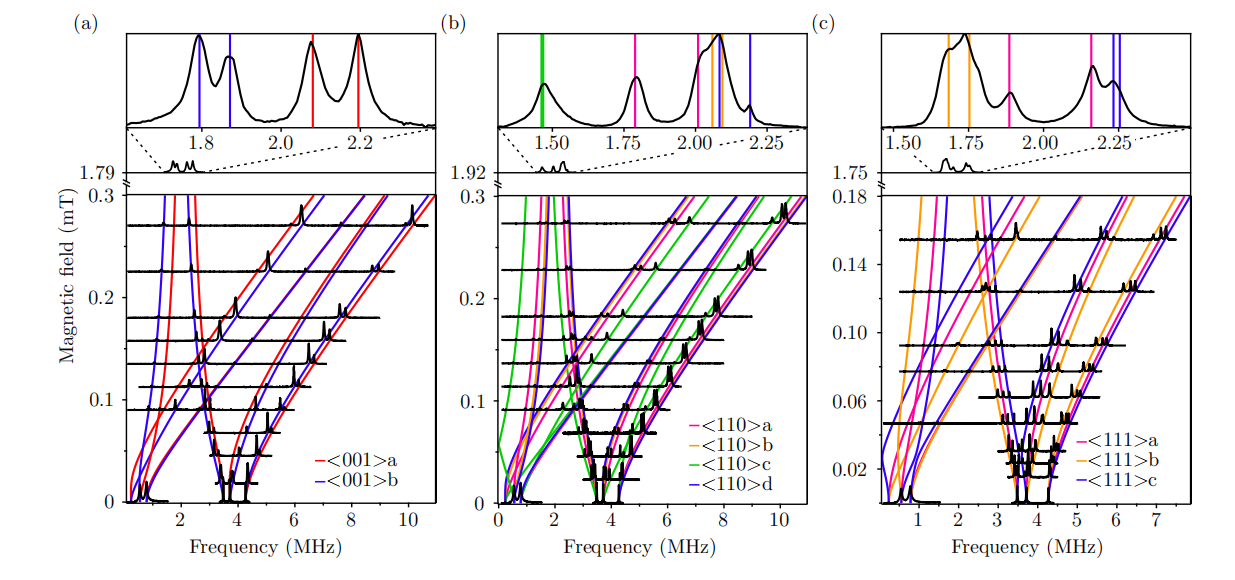
Anisotropic Hyperfine Coupling: The study characterizes the anisotropic hyperfine interaction between the T centre's electron and hydrogen nucleus. The coupling tensor is determined, providing insights into how magnetic fields affect the qubits. The hyperfine coupling is essential for transferring entanglement from communication qubits to memory qubits in the T centre.
Memory Protection and Decoherence: The paper introduces schemes to protect the memory qubit from decoherence during optical excitation. The analysis shows that a dephasing protection manifold (DPM) can be created, where the memory qubit remains coherent even during entanglement operations, especially when aligned with a strong magnetic field. The use of Purcell enhancement and careful field management helps mitigate optically-induced decoherence.
Operational Conditions: By manipulating magnetic field strength and orientation, the authors propose ways to protect the memory qubit from dephasing or relaxation during entanglement procedures. These strategies are essential for maintaining the fidelity of quantum memory over long distances and multiple entanglement attempts.
Applications in Quantum Networks: The T centre is presented as an ideal candidate for brokered entanglement in silicon-based quantum networks. It can facilitate long-distance quantum communication, quantum key distribution (QKD), and distributed quantum computing, making it highly relevant for building scalable, fault-tolerant quantum technologies.
In conclusion, the research establishes the T centre in silicon as a critical platform for quantum networks, providing a pathway to high-fidelity entanglement, quantum communication, and computational tasks. The characterization of its hyperfine structure and the development of memory protection schemes offer valuable tools for future quantum internet applications.
OMeda (Shanghai Omedasemi Co.,Ltd) was founded in 2021 by 3 doctors with more than 10 years of experience in nanpfabrication. It currently has 15 employees and has rich experience in nanofabrication (coating, lithography, etching, two-photon printing, bonding) and other processes. We support nanofabrication of 4/6/8-inch wafers.
