
This article investigates PZT thin films deposited by chemical solution deposition (CSD) on silicon-on-insulator (SOI) substrates for use in high-speed electro-optic modulators. The research focuses on evaluating the dielectric properties of PZT thin films, such as the relative permittivity (εr) and dielectric loss (tan(δ)), at high frequencies (up to 67 GHz). These films are integrated onto SOI waveguides for potential use in next-generation data communication systems.
PZT Thin Film Properties:
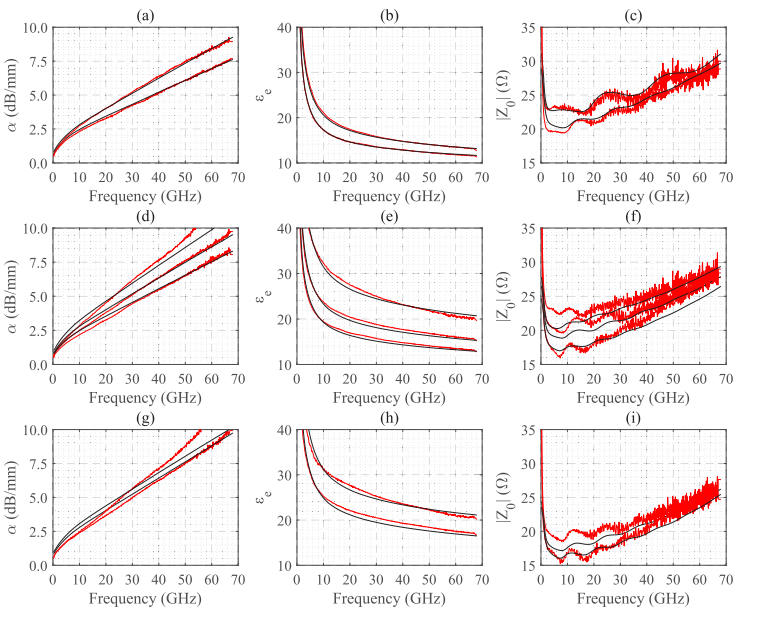
The relative permittivity (εr) of PZT thin films was measured to range from 1650 to 2129 with a loss tangent (tan(δ)) between 0.170 and 0.209 at microwave frequencies (1-67 GHz).
These results were obtained through coplanar waveguide (CPW) transmission lines and S-parameter measurements, providing insights into the high-frequency performance of PZT for electro-optic applications.
Mach-Zehnder Modulator (MZM) Design:
The study explores the use of PZT thin films in Mach-Zehnder modulators (MZM), designed for TE optical modes. The simulation results indicate that bandwidths exceeding 60 GHz are achievable with Vπ ≈ 7V, making PZT a promising candidate for high-speed data communications.
Electrode design and microwave propagation loss are critical factors that influence the modulator's performance, with trade-offs between modulation efficiency and bandwidth explored in the context of device design.
Fabrication and Measurement:
PZT films were deposited on SOI substrates with a lanthanide-based intermediate layer, which helps with film growth and prevents the diffusion of lead. The films were characterized using microwave S-parameters to evaluate their performance in electro-optic modulation.
The results suggest that microwave propagation loss and dielectric loss play a significant role in limiting the bandwidth, particularly at high frequencies. However, the effective permittivity and impedance matching were optimized for better modulation bandwidth.
Design Trade-offs and Optimization:
By adjusting PZT thickness and electrode gap sizes, the modulator's performance can be optimized. Increasing the gap size or reducing PZT thickness generally improves the bandwidth, but may result in a lower modulation efficiency.
Conversely, a thicker PZT layer and narrower gap improve the modulation efficiency but may reduce the bandwidth. The study provides a trade-off analysis for the design of efficient modulators, including modulator length and electrode dimensions.
Future Prospects:
The article highlights the potential of PZT-based modulators for use in silicon photonic platforms, combining low-loss and high-speed properties. The integration of PZT thin films with SOI allows for the fabrication of compact, scalable, and efficient modulators for future high-speed data communication systems.
The study demonstrates that PZT thin films can be successfully integrated into silicon photonic platforms, offering high-speed electro-optic modulation capabilities with the potential for bandwidths beyond 60 GHz. The trade-offs between modulation efficiency and bandwidth were analyzed, providing important insights for the design of next-generation modulators for data communications.
OMeda (Shanghai Omedasemi Co.,Ltd) was founded in 2021 by 3 doctors with more than 10 years of experience in nanpfabrication. It currently has 15 employees and has rich experience in nanofabrication (coating, lithography, etching, two-photon printing, bonding) and other processes. We support nanofabrication of 4/6/8-inch wafers.
