
This article focuses on the high-frequency characterization of lead zirconate titanate (PZT) thin films, which are deposited on silicon-on-insulator (SOI) substrates via chemical solution deposition (CSD) for integrated high-speed electro-optic modulators. These PZT thin films are integrated to enhance the functionality of silicon photonic devices, enabling faster, low-loss modulation for next-generation data communication systems.
Key points include:
High-Frequency Characterization: The study measures the relative permittivity (εr) and dielectric loss (tan(δ)) of PZT thin films in the frequency range of 1-67GHz. The extracted values for the PZT thin films are εr = 1650-2129 and tan(δ) = 0.170-0.209, which indicate the suitability of these films for high-speed modulation.
Sample Fabrication: The PZT films are deposited on SOI substrates with a lanthanide-based intermediate layer that serves as a seed layer for the PZT growth, preventing lead diffusion. The films are fabricated by repeated spin-coating and annealing processes. The coplanar waveguides (CPWs) used for characterizing the films are fabricated with different electrode gap sizes and PZT layer thicknesses.
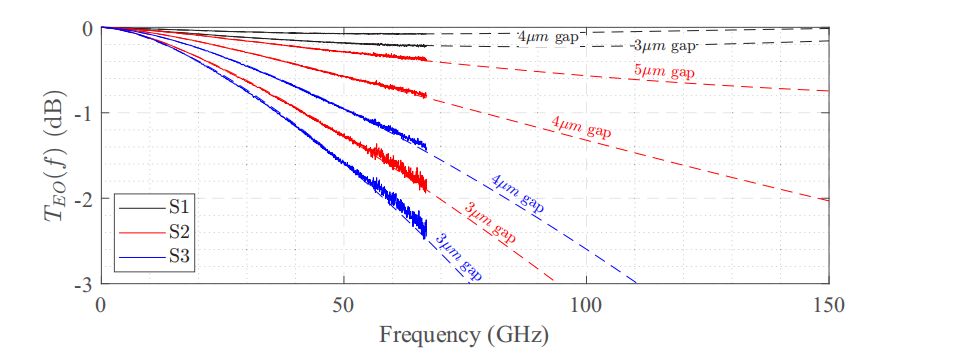
Electro-Optic Modulation Potential: The study shows that the integration of PZT thin films can enable Mach-Zehnder modulators (MZMs) on the SOI platform. The results demonstrate potential bandwidths exceeding 60GHz, with a half-wave voltage (Vπ) of approximately 7V. This is suitable for ultra-fast electro-optic modulators used in high-speed data communication systems.
Design Trade-Offs: The paper discusses the trade-offs between modulation efficiency and bandwidth for MZMs. A thicker PZT layer with a narrower gap enhances the trade-off, balancing bandwidth and modulation efficiency. This optimization is critical for achieving efficient high-speed performance.
Simulations and Results: Simulations are conducted to estimate the modulation bandwidth of PZT-modulated systems, showing that a well-designed modulator could surpass 60GHz bandwidth with minimal loss. The impact of microwave propagation losses and phase velocity mismatch is carefully considered, and methods to mitigate these losses are discussed.
In conclusion, PZT thin films deposited by CSD on SOI substrates show strong potential for integration into high-speed, low-loss electro-optic modulators. These PZT-modulated devices are well-suited for applications in next-generation data communication systems, offering both high performance and scalability.
OMeda (Shanghai Omedasemi Co.,Ltd) was founded in 2021 by 3 doctors with more than 10 years of experience in nanpfabrication. It currently has 15 employees and has rich experience in nanofabrication (coating, lithography, etching, two-photon printing, bonding) and other processes. We support nanofabrication of 4/6/8-inch wafers.
