
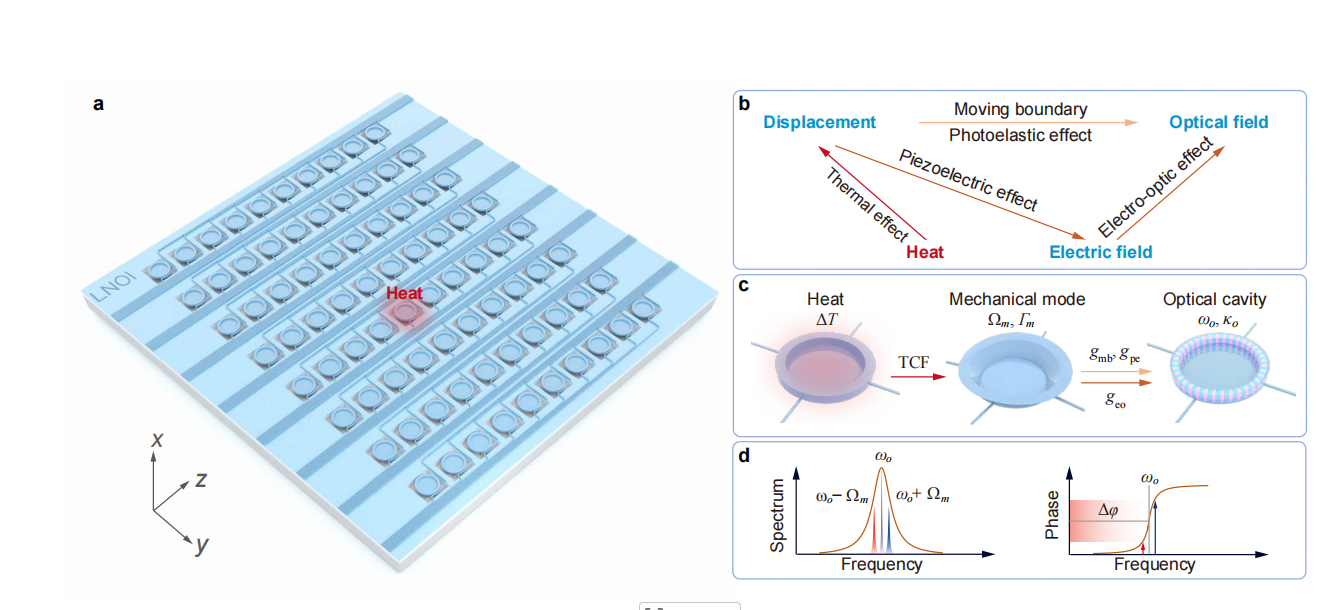
This paper presents the development of an optomechanical platform for thermal sensing based on thin-film lithium niobate (TFLN). The authors leverage the unique properties of lithium niobate, such as low optical loss, strong piezoelectricity, and high intrinsic mechanical quality factors, to design a low-noise, room-temperature platform suitable for highly sensitive thermal sensing.
Key points from the paper include:
Platform Design and Features:
The optomechanical resonators are designed with a suspended microring resonator integrated with ultrathin central membranes, minimizing mechanical stiffness and effective mass while maintaining strong optical and mechanical coupling.
The resonators have dimensions of 40 µm × 40 µm and show high optical quality factors (Qo) and mechanical quality factors (Qm), with Qm values exceeding 1000 at room temperature.
The device features a thermal conductance of 33.5 µW/K and a low thermal capacitance of 440 pJ/K, resulting in a wide thermal bandwidth of 12.2 kHz and high thermal sensitivity.
Performance in Thermal Sensing:
The platform exhibits a temperature coefficient of frequency (TCF) of −124 ppm/K, which is significantly better than other integrated platforms like silicon and silicon nitride.
The noise-equivalent power (NEP) of 6.2 nW/√Hz at 10 kHz demonstrates the device's low-noise performance, crucial for high-precision thermal sensing applications.
Experimental Characterization:
The resonators' performance was measured using techniques like balanced homodyne detection and Pound-Drever-Hall (PDH) locking to suppress laser and readout noise.
The thermal sensitivity and frequency shift due to temperature modulation were characterized, showing a high TCF for different mechanical modes.
Applications:
This integrated platform opens the door to high-sensitivity, uncooled infrared sensing applications, supporting the integration of infrared absorbers and offering potential for large-scale, low-noise sensor arrays.
The combination of thermal sensitivity and strong optomechanical coupling makes the platform promising for a range of sensing applications, including infrared detection, hyperspectral remote sensing, and multifunctional on-chip sensing.
Overall, the work demonstrates a scalable and highly sensitive optomechanical platform on TFLN, capable of achieving low-noise, room-temperature thermal sensing with significant potential for practical applications in integrated sensing systems.
OMeda (Shanghai Omedasemi Co.,Ltd) was founded in 2021 by 3 doctors with more than 10 years of experience in nanpfabrication. It currently has 15 employees and has rich experience in nanofabrication (coating, lithography, etching, two-photon printing, bonding) and other processes. We support nanofabrication of 4/6/8-inch wafers.
