
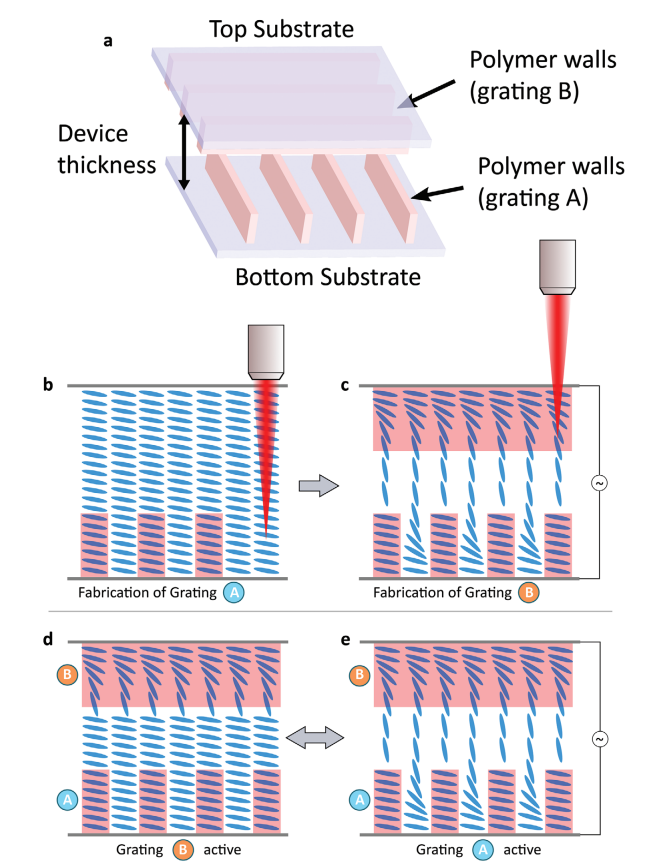
This article discusses the fabrication of 3D switchable diffractive optical elements (DOEs) using two-photon polymerization (2PP) direct laser writing (DLW), a technique that allows for the creation of complex microstructures in transparent photoresists. The key aspects and findings of the paper are:
Introduction to 2PP-DLW and LC Materials:
The paper introduces the use of liquid crystal (LC) materials, specifically a polymerizable LC resist, to create electrically switchable DOEs. By incorporating the LC material into the 2PP-DLW process, the researchers fabricate structures that can be altered in terms of optical properties when an electric field is applied.
Fabrication Process:
The technique uses a femtosecond laser to polymerize the LC mixture, which contains reactive mesogens, under a controlled electric field. The 2PP-DLW process allows for the creation of bilayer structures, with multiple DOEs encoded at different depths within the LC material.
The key innovation is that the optical elements can be switched between two distinct diffraction modes simply by applying different voltages during the fabrication process, enabling multi-element devices to be designed.
Switchable Bilayer DOEs:
The paper demonstrates the creation of bilayer switchable DOEs, where each layer represents a different diffraction grating. These gratings are made to operate in reverse-mode and conventional mode, offering flexibility in how the device behaves based on applied voltage.
The DOEs show the ability to switch between different optical patterns, such as orthogonal 1D diffraction gratings, depending on the voltage applied. This results in an optical device that can alternate between two distinct diffraction patterns, such as those generated by binary-phase computer-generated holograms (CGHs).
Demonstration with Computer-Generated Holograms (CGHs):
The paper showcases the use of these switchable DOEs to generate computer-generated holograms. One hologram reproduces the University of Oxford logo, while the other produces the Somerville College crest. By changing the applied voltage, the optical pattern switches between these two CGHs.
Applications and Advantages:
The presented technology could be beneficial for applications such as 3D depth mapping and holography, where multi-functionality and switchability of optical elements are crucial. This approach offers an advantage over conventional devices because it is simpler to produce and does not require complex backplane electronics or pixelated arrays.
The device is also transmissive, meaning it can be more easily incorporated into various optical systems, making it suitable for a range of practical applications.
Potential Impact:
The work represents a significant step forward in the development of switchable diffractive optical elements, providing a more flexible and affordable alternative to traditional, complex optical systems. The ability to design and fabricate custom, switchable optical elements without the need for intricate electronics is a promising advancement in optical technology.
In summary, the paper demonstrates the successful fabrication of switchable LC-based DOEs using 2PP-DLW, which can be controlled electrically to produce distinct diffraction patterns. These devices are compact, simple to produce, and highly versatile, offering significant potential for various optical applications.
