
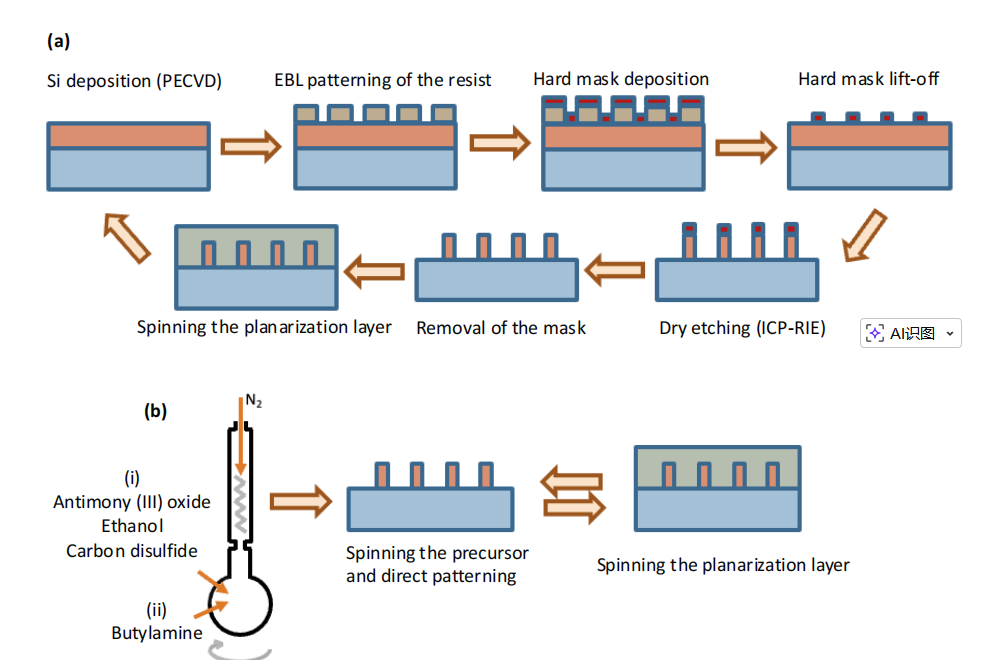
This article introduces a novel high-throughput direct-write lithography method for fabricating multilayer resonant metasurfaces, specifically focusing on optical filters based on the quasi-bound states in the continuum (q-BIC) principle. The technique is based on an antimony (Sb) precursor that decomposes into high-index Sb₂S₃ during electron-beam lithography (EBL). The approach reduces fabrication complexity, eliminates deposition–etch cycles, and enables efficient multilayer metasurface fabrication.
Direct-Write Lithography for High-Throughput Fabrication:
The article presents a direct-write electron-beam lithography method using an antimony precursor, which decomposes in situ to form Sb₂S₃. This method simplifies the process by reducing it to only two steps per layer: spin-coating the precursor and electron-beam patterning. This process eliminates the need for time-consuming deposition, etching, and planarization steps traditionally used in multilayer fabrication.
Multilayer Resonant Metasurfaces:
The technique is applied to fabricate multilayer metasurfaces that support q-BIC-like resonances. These metasurfaces have independently tunable resonance wavelengths and quality factors (Q-factors) across different layers, allowing precise spectral control. The authors demonstrate three-layer devices supporting three distinct resonances with independently tunable properties, including resonance wavelength and linewidth.
Applications in Spectral Filtering and Hyperspectral Reconstruction:
By creating multilayer metasurfaces with spectrally decoupled layers, the study highlights their potential for use in spectral filtering, compressive sensing, and hyperspectral imaging. The ability to design multiple independent resonances within a single device enables the construction of filter arrays with minimal spectral overlap, which is critical for applications requiring high-resolution spectral reconstruction.
Filter Array for Compressive Sensing:
The authors generate filter arrays with low correlation between individual filters. By minimizing the pairwise correlation between the filter responses, they demonstrate a significant improvement in compressive sensing and hyperspectral reconstruction. They achieve average Pearson correlation coefficients of 0.11 and 0.21 for sets of 9 and 36 filters, respectively, outperforming previous metasurface and photonic crystal designs in terms of spectral decorrelation.
Device Design and Experimental Results:
The article details the design and experimental demonstration of multilayer devices, showing the independent tunability of each layer's resonance characteristics. Through simulations and experimental measurements, the authors verify that each layer’s resonance can be tuned independently without affecting the performance of other layers, even for complex multi-resonant metasurfaces.
High-Resolution Spectral Control:
The metasurfaces demonstrated in this study allow for high-resolution control of spectral properties by tuning the geometry of the unit cell, specifically through the lattice scaling parameter (α) and rotation angle (θ). These tunable parameters provide a versatile platform for designing spectral filters with diverse features.
This work establishes a scalable and efficient fabrication method for multilayer resonant metasurfaces, enabling high-throughput fabrication of complex optical filters. By leveraging the ability to independently control resonance wavelengths and Q-factors across multiple layers, the study paves the way for developing compact, high-performance devices for applications in spectral filtering, on-chip spectroscopy, and compressive sensing.
OMeda (Shanghai Omedasemi Co.,Ltd) was founded in 2021 by 3 doctors with more than 10 years of experience in nanpfabrication. It currently has 15 employees and has rich experience in nanofabrication (coating, lithography, etching, two-photon printing, bonding) and other processes. We support nanofabrication of 4/6/8-inch wafers.
