
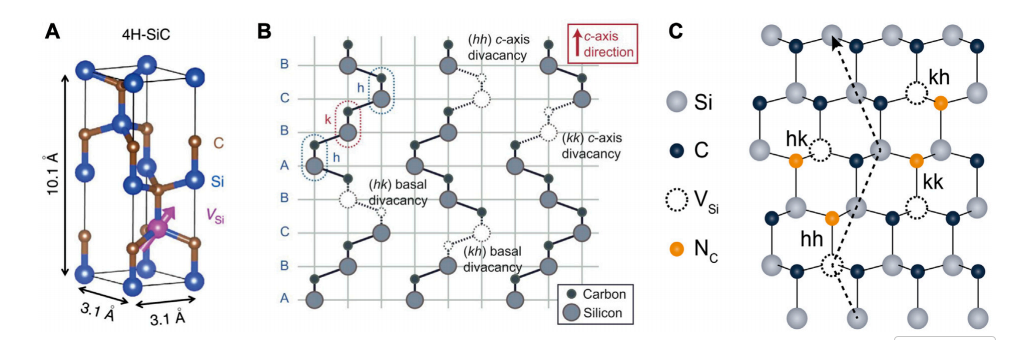
The paper titled "Fabrication and Quantum Sensing of Spin Defects in Silicon Carbide" reviews the progress in the fabrication and quantum sensing applications of spin defects in silicon carbide (SiC). It outlines the three main types of spin defects in SiC: silicon-vacancy centers, divacancy centers, and nitrogen-vacancy centers. These defects exhibit promising properties for quantum technologies, such as quantum photonics, quantum information processing, and quantum sensing.
The article discusses various fabrication methods, including electron or neutron irradiation, ion implantation, focused ion beam implantation, and laser writing. It emphasizes the advantages and challenges of each technique in creating these spin defects with high efficiency and precision.
The review also delves into the various quantum sensing applications of SiC spin defects, such as magnetic field, electric field, temperature, strain, and pressure sensing. It highlights the sensitivity and spatial resolution of these sensors, particularly at room temperature, making them suitable for various fields including physics, biology, and material science.
The paper concludes by exploring the future potential of SiC spin defect-based quantum sensing, focusing on improving fabrication techniques and sensitivity through methods like using photonic structures and isotope purification.
This comprehensive overview presents SiC as a promising platform for advancing quantum technologies, especially in sensing applications.
