
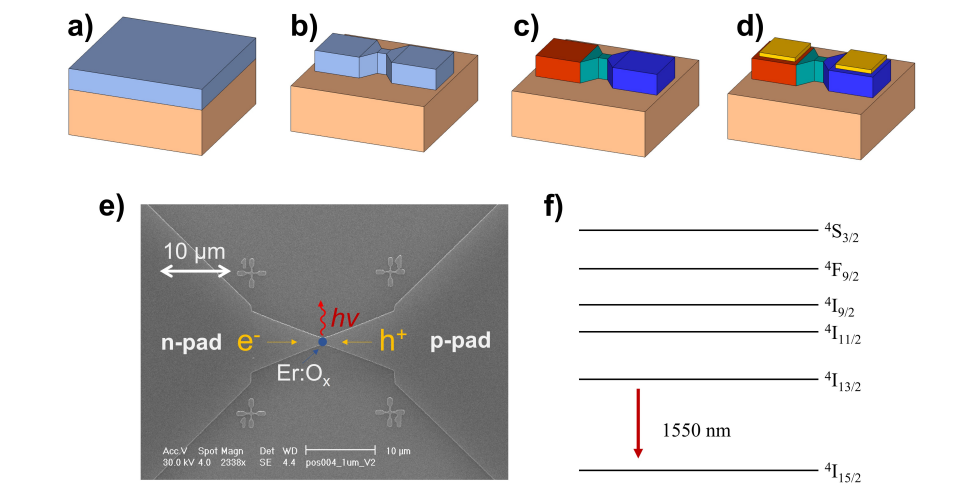
The article, "Fully Integrated Silicon Photonic Erbium-Doped Nanodiode for Few Photon Emission at Telecom Wavelengths," presents a new approach for quantum key distribution (QKD) using silicon photonic devices. The key innovation is the development of erbium-doped silicon light-emitting diodes (LEDs) integrated on a silicon-on-insulator (SOI) platform, operating at telecom wavelengths around 1550 nm, which is ideal for QKD applications.
Here are the main points of the article:
Erbium-Doped Diodes: The study focuses on silicon LEDs that utilize electroluminescence from erbium-oxygen (Er:O) complexes. These diodes are fabricated on a 220 nm-thick silicon-on-insulator (SOI) wafer, which is compatible with CMOS processes, ensuring ease of integration into silicon photonics.
Fabrication and Doping: The devices are created using a top-down process, including electron beam lithography, ion implantation, and rapid thermal annealing. The erbium doping is combined with oxygen to form Er:O complexes, enhancing the emission yield at room temperature.
Photon Emission for QKD: The erbium-based diodes emit photons at 1550 nm, which is the optimal wavelength for fiber optic communication. The emission rate of the 1 µm × 1 µm device is around 5 × 10⁶ photons per second at room temperature, which is suitable for QKD protocols that require weak photon sources.
Electromagnetic Simulations: The study also includes simulations using Finite-Difference Time-Domain (FDTD) to model the photon emission characteristics of the devices. The simulations help in understanding the vertical emission of photons and assessing the impact of fabrication errors on performance.
Experimental Results: The article reports on the experimental characterization of the erbium-doped diodes, showing that the emission yield increases with oxygen co-doping. Devices with smaller dimensions (1 µm × 1 µm) exhibited lower photon counts, but the results still demonstrate the feasibility of creating integrated silicon photon sources for QKD.
Future Directions: The authors propose further improvements, including the use of waveguides to collect more emitted photons and optimize the performance of the device for practical QKD applications.
In conclusion, the work presents a significant step toward integrating photon sources on silicon platforms for use in quantum communication, particularly in applications such as QKD, where weak photon sources at telecom wavelengths are essential.
