
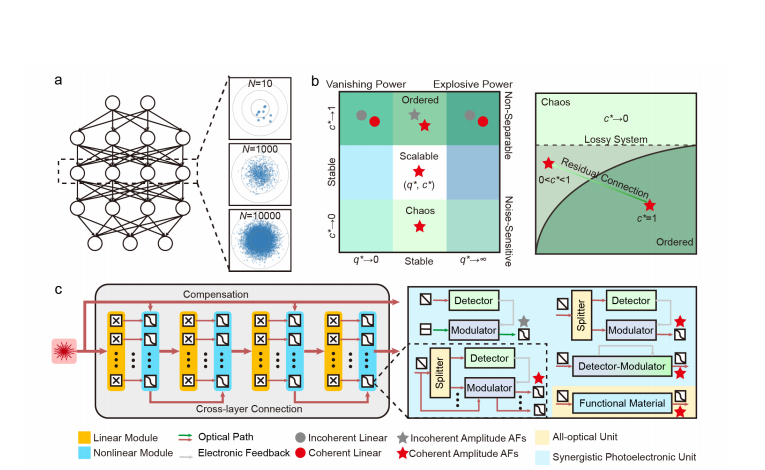
The article presents a novel architecture for photonic deep learning, addressing scalability challenges in photonic neural networks (PNNs). The authors propose the Coherent, Compensated, and Cross-connected (C3) unit, which integrates coherent amplitude nonlinearity, active loss compensation, and native optical residual connectivity to enable scalable, high-performance PNNs on a silicon-on-insulator platform. This framework overcomes key limitations of existing photonic computing systems, such as weak optical nonlinearities and loss-induced power instability.
Key findings from the study include:
Theoretical Foundation: The authors establish a theoretical framework based on statistical field theory, identifying two macroscopic order parameters—optical power and complex-field correlation—as key descriptors for scalable PNNs. The study reveals that coherent amplitude activation functions (AFs) are essential for maintaining stable, scalable network dynamics, as incoherent systems tend to lose expressivity.
C3 Unit Design: The C3 unit is designed to implement coherent nonlinearity and stabilize power fluctuations while maintaining complex-field correlations. It uses a combination of Mach-Zehnder modulators and photodetectors, with feedback loops that tune the resonator’s loss and resonance dynamically, providing tunable coherent activation and energy stabilization. The C3 unit is further enhanced by cross-layer optical residual connections, which bypass contractive operations and stabilize network performance.
Experimental Validation: The C3 unit is validated experimentally through two tasks: a five-class spiral classification benchmark and a 1,623-class Omniglot recognition task. In both cases, C3-enabled networks demonstrate superior performance compared to incoherent or non-residual architectures. The C3 unit improves parameter utilization, robustness to input-power variations, and model scalability, with the CoP-ResNet achieving 77.92% accuracy on the Omniglot task.
Scalability and Robustness: The C3-based networks show significant performance gains in width-constrained settings, where traditional models would struggle with power loss and diminishing nonlinearity. The incorporation of local-oscillator (LO) injection stabilizes the power and nonlinearity, ensuring robust performance over a broad range of input powers.
Device Design and Operational Principle: The C3 unit integrates phase-preserving coherent amplitude nonlinearities with dynamic loss compensation and residual connectivity. The device is fabricated using standard silicon photonics foundry processes, and the nonlinear activation functions are characterized by measuring output power and signal-power splitting ratios, confirming the successful implementation of tunable activation behavior.
Impact on Photonic Computing: The results establish a physically grounded pathway for building scalable, deep photonic neural networks capable of processing complex tasks in real-time. The C3 unit’s combination of coherent activation, power stabilization, and residual connectivity lays the foundation for future large-scale photonic computing architectures, offering a promising approach to overcoming the limitations of electronic-based AI systems.
In conclusion, this study demonstrates a new photonic deep learning architecture that offers high scalability, robust performance, and practical integration with silicon photonics, making it a significant step toward advanced optical computing systems for AI applications.
