
The article provides a detailed investigation into the spin-photon interface of single PL6 color centers in silicon carbide (SiC), which has emerged as a promising platform for quantum information processing. The study focuses on key characteristics such as spin initialization fidelity, optical coherence, and spin-photon entanglement potential.
Key findings from the study include:
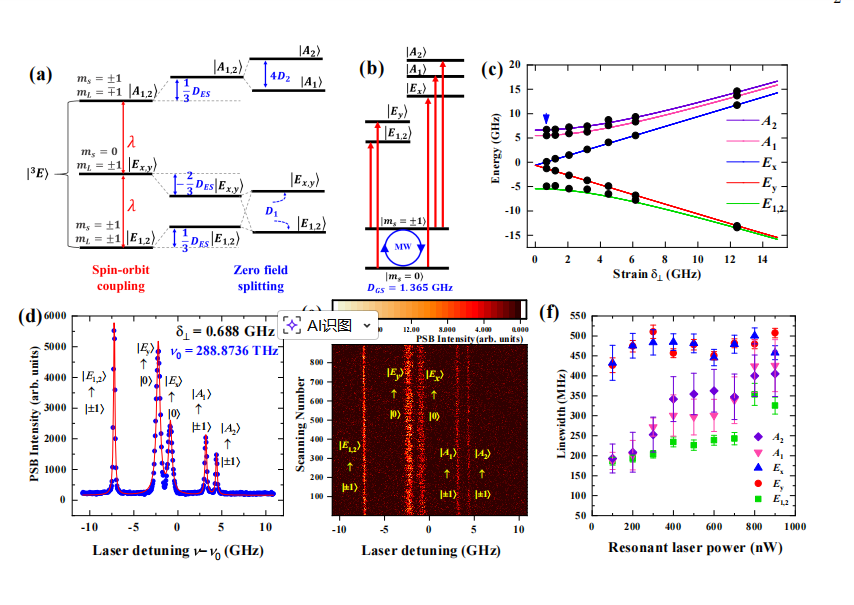
Excited-State Fine Structure: The study uses group-theoretical modeling and strain-dependent measurements to resolve the fine structure of the excited state of PL6 centers. The energy levels are split due to spin-orbit coupling and spin-spin interactions, with the transverse strain being the dominant factor.
Spin Initialization and Readout: The research demonstrates high-fidelity spin initialization and readout under resonant excitation, achieving a spin initialization fidelity of 99.69% and a readout contrast of 98.31%, which is comparable to the best-performing systems for similar solid-state quantum emitters like NV centers in diamond.
Coherent Control and Optical Rabi Frequencies: The PL6 centers exhibit narrow optical linewidths (∼180 MHz) and polarization visibility of about 82%, enabling high spectral purity for optical addressing. The optical Rabi frequencies reach up to 2.895 GHz, allowing rapid quantum operations.
Dynamical Decoupling and Coherence Time: Dynamical decoupling significantly extends the spin coherence time, increasing it from 0.5 ms to 5.70 ms, showcasing an order-of-magnitude enhancement in coherence.
Spin-Photon Entanglement: The PL6 centers demonstrate spin-photon entanglement via the |A2⟩ excited state, which has a Λ-type spin-photon polarization entanglement structure, analogous to NV centers in diamond. The polarization visibility of the |ms = ±1⟩ ↔ |A2⟩ transition was found to be approximately 82%, indicating strong spin-photon correlations.
Decoherence Time and Dynamical Decoupling: The study also explores decoherence times using dynamical decoupling techniques. The Hahn-echo measurements at various magnetic fields reveal that the decoherence time increases significantly with dynamical decoupling, and the spin coherence improves with the number of decoupling pulses.
The article concludes that PL6 centers in SiC exhibit exceptional spin-optical properties, long coherence times, and efficient spin-photon entanglement, making them a competitive system for quantum networks and photonic quantum information processing. The results provide a pathway for using PL6 centers for high-fidelity quantum operations in solid-state systems.
