
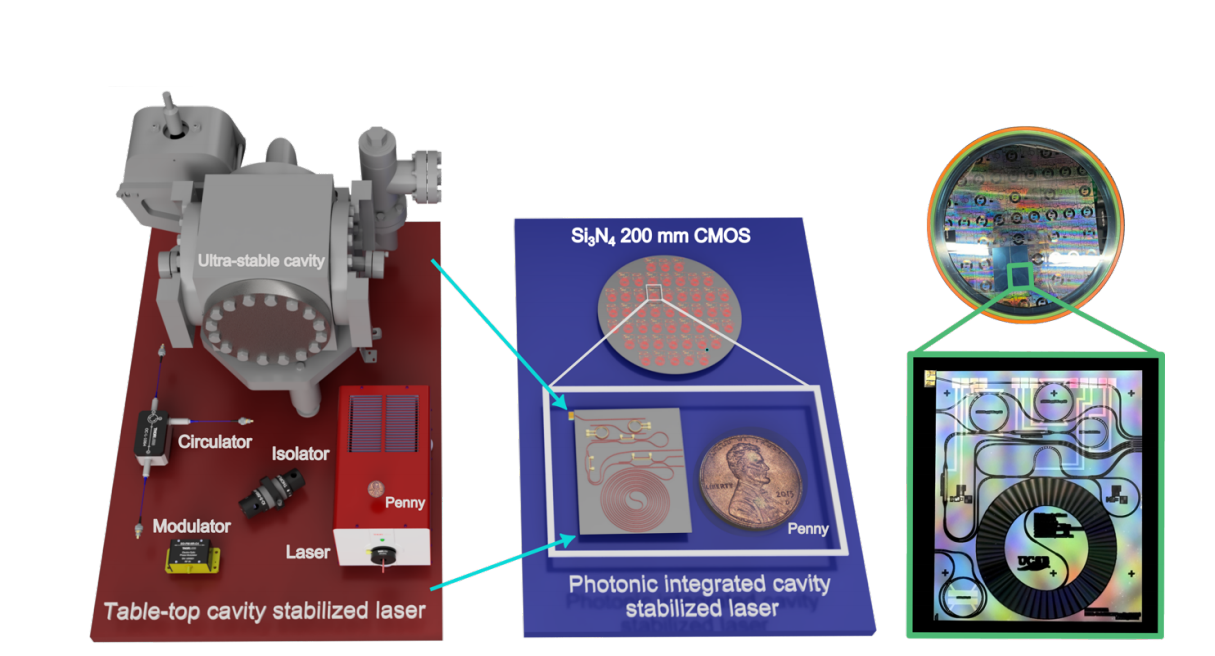
The article discusses the integration of precision stabilized lasers on a chip using a silicon nitride (SiN) photonic platform. The work demonstrates two types of stabilized lasers: a widely tunable self-isolating extended cavity tunable laser (ECTL) and a self-isolating stimulated Brillouin scattering (SBS) laser, both incorporating a modulation-free coil-loaded Mach-Zehnder interferometer (CL-MZI) for frequency stabilization. This integration eliminates the need for bulky optical components like modulators, isolators, and circulators, offering a compact, scalable, and cost-effective solution for precision laser systems.
Key findings from the study include:
Chip Integration: The laser and stabilization photonics are integrated into a 200 mm CMOS-compatible SiN photonic chip, which includes self-isolating lasers and a modulation-free coil-loaded MZI for stabilization. The lasers use off-chip hybrid-integrated semiconductor optical amplifiers (RSOAs) and external photodiodes for frequency noise reduction via Pound-Drever-Hall (PDH) locking.
Performance of Stabilized ECTL: The ECTL laser is highly tunable across nearly 60 nm, with fundamental linewidths (FLWs) measured between 1.65 Hz and 10.48 Hz, depending on the wavelength. The integrated laser achieves low frequency noise and high stability with an Allan deviation (ADEV) of 6.5 × 10⁻¹³ at 0.08 ms.
SBS Laser: The SBS laser design offers high-frequency noise suppression and sub-Hz-level fundamental linewidths (4 Hz) with an ADEV of 2.8 × 10⁻¹³ at 5 ms. The SBS laser design includes a self-isolating mechanism that reduces high-frequency noise through nonlinear scattering while being stabilized using the on-chip CL-MZI.
Modulation-Free Stabilization: The article highlights the use of a modulation-free stabilization technique that leverages the coil-loaded MZI for frequency discrimination, generating an error signal for laser frequency feedback without requiring additional modulators or active components. This method allows for greater stability and precision in laser performance.
Frequency Noise Suppression: The lasers demonstrate over six orders of magnitude frequency noise reduction. Both the ECTL and SBS lasers show frequency noise suppression in the 100 Hz to 500 kHz frequency range, with the ECTL reaching a frequency noise floor limited by thermorefractive noise (TRN).
Versatility and Scalability: The work demonstrates that the same on-chip reference cavity can stabilize both ECTL and SBS lasers, showcasing the general applicability of the design for various laser types. The technology is scalable to the visible and short-wave infrared (SWIR) ranges and can be integrated with additional on-chip components like piezoelectric actuators, photodiodes, and CMOS electronics for further functionality.
In conclusion, this research paves the way for portable, chip-scale precision lasers suitable for quantum technologies, sensing, and communications. By integrating the entire laser stabilization system onto a single photonic chip, it offers a path toward scalable, low-cost, and manufacturable solutions for various precision measurement applications.
