
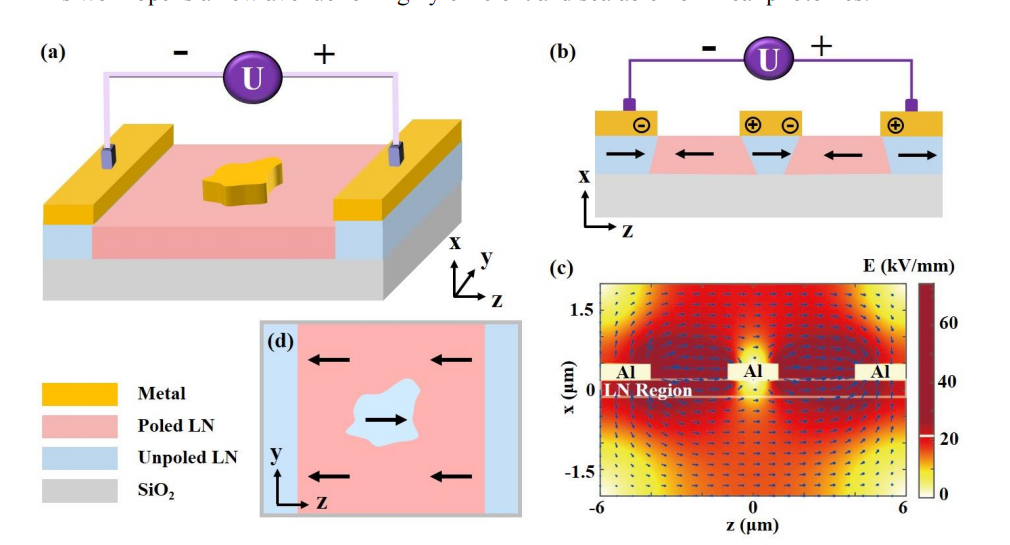
The article introduces a novel domain engineering technique based on the Faraday cage effect to enhance the fabrication of high-efficiency thin-film lithium niobate (TFLN) photonics, specifically for second-harmonic generation (SHG). This technique aims to address the challenges in precise and robust fabrication of nonlinear photonic devices, which have traditionally been hindered by the complex dynamics of domain inversion during poling.
Key findings include:
Faraday Cage-Based Domain Engineering: The method utilizes nanoscale metal structures to locally shape the electric field during poling, preventing domain inversion in specific areas, thus defining unpoled regions based on the geometry of the Faraday cages. This provides precise control over the polarity distribution without requiring real-time monitoring.
Spatially Selectively Poled TFLN (SSP-TFLN) Waveguide: As a proof of concept, the technique was applied to fabricate a spatially selectively poled TFLN waveguide. The waveguide achieved modal phase matching (MPM) between the TE₀₀ fundamental mode and the TE₂₀ second-harmonic mode, resulting in a normalized SHG conversion efficiency of 6242 %W⁻¹cm².
Enhanced SHG Efficiency: Simulated results and experimental data showed that the proposed domain engineering method significantly improved the SHG efficiency by optimizing the mode overlap factor and minimizing the refractive index difference between the fundamental and second-harmonic light.
Robustness of the Approach: The technique was shown to be highly robust, as it effectively prevents the common issues of nonuniform domain growth caused by surface defects, adsorbed charges, and electrode imperfections that typically occur in conventional electric-field poling methods. The unpoled regions were consistently defined by the nano-metal patterns, enabling reliable fabrication.
Inverted Domain Growth Dynamics: The study used piezoelectric force microscopy (PFM) to observe the growth dynamics of the inverted domains during the poling process. The results confirmed that the nano-metal structures successfully controlled the size and position of the unpoled regions, ensuring the precision of the fabricated waveguides.
Device Characterization: The SHG performance of the fabricated devices was thoroughly characterized. The SSP-TFLN waveguides demonstrated excellent SHG conversion efficiency (6224 ± 400 %W⁻¹cm²), significantly outperforming unpoled waveguides. The method also showed consistent results across various poling pulse durations, further proving its robustness and scalability.
Future Applications: This domain engineering approach can be extended to other waveguide geometries, including double-layer TFLN waveguides and periodically poled structures, for even more efficient SHG. It also opens up new possibilities for highly efficient nonlinear photonics with precise and scalable fabrication methods.
In conclusion, this work presents a new and highly effective method for controlling the ferroelectric domain distribution in TFLN waveguides, enabling the reliable fabrication of high-efficiency SHG devices. This approach holds great potential for the development of scalable nonlinear photonic circuits, particularly for quantum photonics and other advanced optical technologies.
OMeda (Shanghai Omedasemi Co.,Ltd) was founded in 2021 by 3 doctors with more than 10 years of experience in nanpfabrication. It currently has 15 employees and has rich experience in nanofabrication (coating, lithography, etching, two-photon printing, bonding) and other processes. We support nanofabrication of 4/6/8-inch wafers.
