
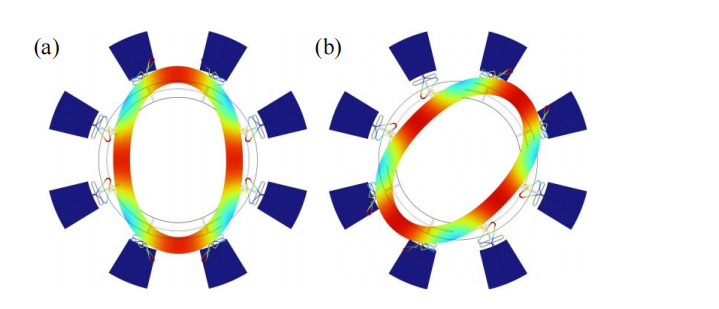
This study presents a high-performance piezoelectric MEMS yaw gyroscope based on lead-free aluminum nitride (AlN), fabricated on a 〈111〉 single-crystal silicon device layer. The gyroscope features a wide annular resonator operating in the second-order in-plane wineglass mode at 132 kHz, achieving a mechanical quality factor (Q) of 75,000—the highest reported among silicon-based piezoelectric gyroscopes.
Key innovations include:
Geometry and Mode Optimization: Analytical modeling links output charge to area-integrated in-plane stress under vibration. The annular width is optimized to enhance both the mechanical Q-factor and piezoelectric transduction efficiency. A 16-sector electrode layout aligns with the stress distribution to prevent charge cancellation.
Backside Trench Fabrication: The device is fabricated without front-side release holes, preserving structural continuity and minimizing thermoelastic damping (TED), a primary source of intrinsic loss in MEMS resonators.
Multiphysics Simulation: Finite element analysis evaluates the interplay between structural geometry, TED-limited Q, and piezoelectric transduction. Parametric sweeps of annular width indicate that an optimal width of 420 μm balances high Q, strong electromechanical coupling, and manageable resonance frequency.
Experimental Validation: The gyroscope is characterized under vacuum (~0.01 Pa), yielding a resonant frequency of ~132 kHz with a 28 Hz frequency split. Open-loop measurements show an angular random walk (ARW) of 0.34°/√h and bias instability of 8.19°/h. These metrics rival state-of-the-art lead-based PZT devices while using an environmentally friendly, RoHS-compliant AlN material.
Overall, the study demonstrates that careful co-design of resonator geometry, electrode placement, and fabrication process enables high-Q, lead-free piezoelectric MEMS gyroscopes with performance comparable to traditional PZT-based gyros, providing a sustainable pathway for high-precision inertial sensing applications.
OMeda (Shanghai Omedasemi Co.,Ltd) was founded in 2021 by 3 doctors with more than 10 years of experience in nanpfabrication. It currently has 15 employees and has rich experience in nanofabrication (coating, lithography, etching, two-photon printing, bonding) and other processes. We support nanofabrication of 4/6/8-inch wafers.
