
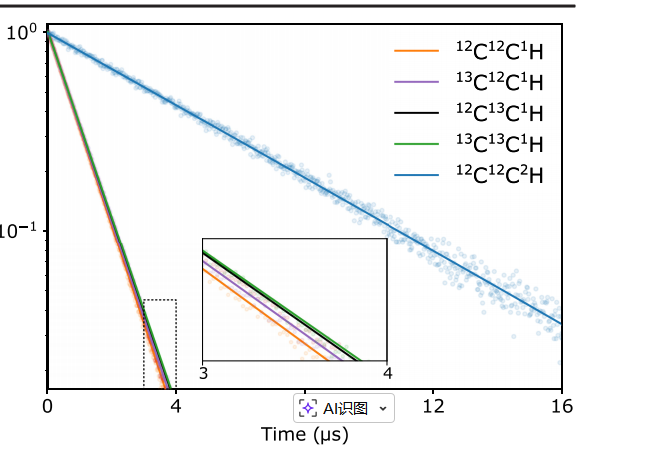
The article investigates the isotope-dependent excited-state lifetime and emission efficiency of the silicon T center, a promising single-photon emitter for quantum technologies. Specifically, the study reveals a strong isotope effect: the excited-state lifetime of deuterium T centers is more than five times longer than their protium counterparts.
Key points:
The T center consists of a carbon-hydrogen complex in silicon, and its isotopic variants include deuterium (12C12C2H), with natural hydrogen being the common protium variant (12C12C1H). These variants significantly influence the center's properties.
The deuterium T center exhibits a significantly longer excited-state lifetime, which is attributed to a reduction in nonradiative decay due to the lower energy of the C-H stretching mode in the deuterium variant compared to protium.
The study also reports detailed experiments on photoluminescence spectra and lifetimes of various isotopic variants of the T center (natural, deuterium, and 13C-enriched), revealing substantial lifetime enhancements in deuterium T centers, which could potentially approach unit quantum efficiency.
The observed lifetime difference is explained by first-principles calculations, where the reduced phonon energy of the C-H stretch mode in deuterium leads to a suppression of nonradiative decay channels.
The deuterium T center's performance improvement has significant implications for quantum technologies, particularly in quantum networks, single-photon sources, quantum memories, and readout of electron spin.
The findings highlight the potential of isotope engineering for improving the efficiency of silicon-based quantum emitters and open new possibilities for high-performance quantum devices.
OMeda (Shanghai Omedasemi Co.,Ltd) was founded in 2021 by 3 doctors with more than 10 years of experience in nanpfabrication. It currently has 15 employees and has rich experience in nanofabrication (coating, lithography, etching, two-photon printing, bonding) and other processes. We support nanofabrication of 4/6/8-inch wafers.
