
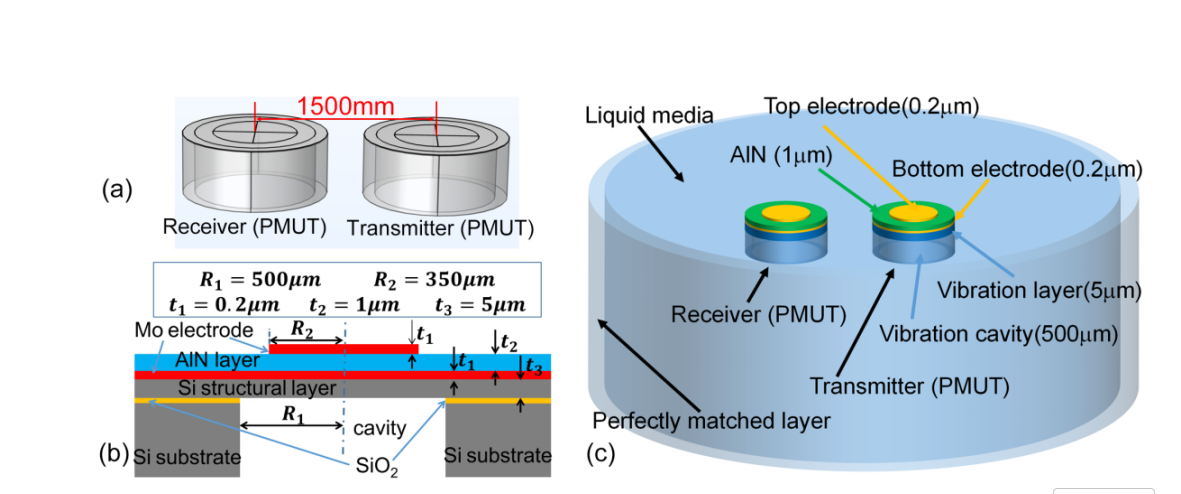
The paper presents a novel liquid density sensor based on AlN (Aluminum Nitride) piezoelectric micromachined ultrasonic transducers (PMUTs), which is insensitive to liquid viscosity variations. This sensor utilizes two identical PMUTs (transmitter and receiver) to generate and receive ultrasonic waves that are reflected from the liquid surface, with the amplitude of the received signal directly related to the liquid's density.
Key findings:
Design and Functionality: The sensor operates at a fixed excitation frequency, and the amplitude of the electrical signal received by the PMUTs has a specific relationship with the liquid density. This design eliminates the coupling effect between viscosity and density, a common issue in traditional liquid density measurement methods.
Theoretical and Experimental Results: The sensor was calibrated using glycerol solutions, and it accurately measured the density of other liquids, such as propylene glycol, within a range of 1.013 to 1.056 g/cm³. The error rate for propylene glycol was found to be below 0.125%. In high-viscosity environments (80%-100% glycerol solutions), the error rates were still under 2.5%, which is significantly lower than methods based on resonant frequency.
Performance Metrics: The sensor demonstrated a Q value of 76.8 in pure water and an output signal-to-noise ratio (SNR) of up to 126 dB. The detection resolution was evaluated at 2.6×10⁻⁴ g/cm³.
Applications and Benefits: The proposed PMUT liquid density sensor is highly reliable, offers low power consumption, and is insensitive to viscosity variations, making it suitable for applications in various fields such as biomedical analysis, chemical process monitoring, and automatic control.
The study also discusses the simulation results, design optimization, and the impact of manufacturing-induced dimensional errors on device performance, confirming that the sensor can accurately measure liquid density across a wide range of liquids with minimal influence from viscosity.
OMeda (Shanghai Omedasemi Co.,Ltd) was founded in 2021 by 3 doctors with more than 10 years of experience in nanpfabrication. It currently has 15 employees and has rich experience in nanofabrication (coating, lithography, etching, two-photon printing, bonding) and other processes. We support nanofabrication of 4/6/8-inch wafers.
