
The article discusses the use of color centers in silicon carbide (SiC) for nuclear spin control without relying on traditional radio-frequency (RF) fields. Specifically, it demonstrates that by utilizing a modified divacancy center in SiC, nuclear spin control can be achieved with microwave (MW) pulses, driven by electron spin manipulation. This RF-free approach simplifies quantum systems by reducing power consumption and experimental complexity, offering a scalable solution for quantum technologies like sensing and computing.
Key findings include:
SiC Color Centers and Nuclear Spin Control: The research focuses on PL6 centers in SiC, which exhibit high photon count rates and spin readout contrasts at room temperature, making them promising for quantum applications.
Coherent Nuclear Spin Control: The study presents methods for coherent nuclear spin manipulation without RF fields. The precession of nuclear spins, driven by hyperfine interactions and external magnetic fields, provides a sensitive probe of magnetic-field orientation.
Experimental Results: The authors demonstrate high-fidelity control of nuclear spins, achieving a two-qubit tomography fidelity of 89%, with nuclear coherence times approaching the T1 limit.
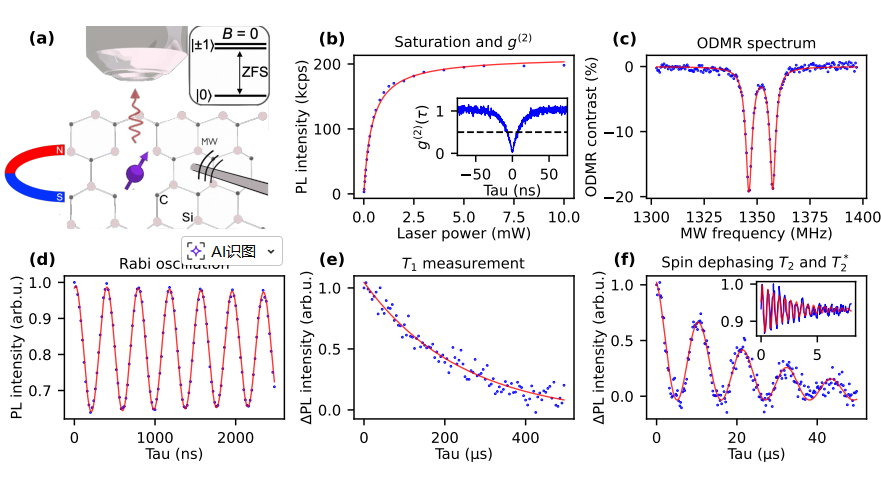
Spin Properties and Characterization: Detailed characterizations of PL6 centers, including Rabi oscillations, T1, T2, and T2* measurements, confirm the robustness of the system's spin properties for quantum applications.
The article's significance lies in its ability to control both electron and nuclear spins with minimal external fields, paving the way for scalable and efficient quantum devices. The approach reduces the need for complex RF setups and is well-suited for future quantum technologies.
