
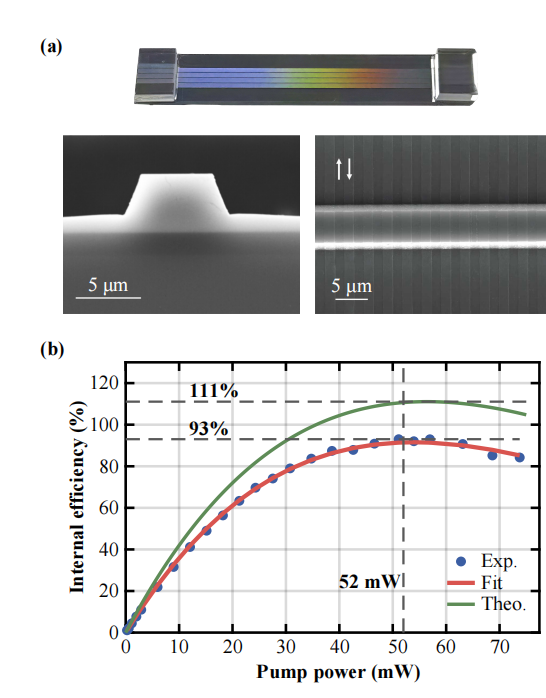
The article focuses on high-performance quantum frequency conversion (QFC) from ultraviolet (UV) to telecom bands, a critical advancement for enabling long-distance quantum networks. The authors achieve efficient conversion of UV photons (393 nm) from 40Ca+ ions to the telecom C-band (1550 nm) using a thin-film lithium niobate (TFLN) waveguide, which benefits from first-order quasi-phase matching (QPM) with a period of 3.07 µm.
Key findings from the study include:
Domain Defect Impact: The authors present a theoretical model to evaluate the impact of domain defects in short-period phase-matched waveguides. They find that the critical tolerance for domain defects is ≤ 2, with defects significantly affecting the conversion efficiency. By optimizing the fabrication process, they achieve a normalized conversion efficiency (ηnor) of 839%/(W·cm²), surpassing theoretical predictions.
Noise Suppression Strategy: A novel noise suppression strategy is proposed, utilizing the counter-tuning behaviors of difference-frequency generation (DFG) and spontaneous parametric down-conversion (SPDC) processes. This approach leads to a threefold reduction in noise levels, achieving a record-low noise of 35 counts per second, with a high external efficiency of 28.8%.
QFC Performance: The QFC system demonstrates outstanding performance with an external efficiency of 28.8% and a noise level of 35 cps, which is more than 30 times higher in efficiency and two orders of magnitude lower in noise than previous reports. This performance meets the stringent requirements for practical quantum communication, particularly for long-lived remote ion-ion entanglement in scalable quantum networks.
Propagation Loss and Normalized Efficiency: The study incorporates propagation loss measurements at different wavelengths (393 nm, 527 nm, and 1550 nm) and refines the efficiency model to account for these losses. The optimized QFC module achieves a theoretical efficiency of 839 ± 20 %/(W·cm²), consistent with the experimental values.
Long-Term Stability: The setup shows excellent long-term stability, with the pump transmission monitored over 48 hours. The system demonstrated a relative fluctuation of only 1.4%, making it suitable for extended operations in quantum network applications.
Future Applications: This high-efficiency QFC interface sets a new benchmark for UV-to-telecom conversion, making it applicable to quantum memories in ion-trap systems operating at other wavelengths such as 369 nm (171Yb+), 422 nm (88Sr+), and 493 nm (138Ba+). The methodology can be applied to other QFC processes, offering potential for hybrid quantum networks.
In conclusion, the article provides a detailed solution to the challenges of UV-to-telecom quantum frequency conversion, achieving high efficiency and low noise, and demonstrating a significant step toward scalable quantum networks and long-distance quantum communication.
