
The paper you uploaded discusses the fabrication and integration of high-stress silicon nitride (Si₃N₄) membranes with distributed Bragg reflectors (DBRs) for cavity optomechanics. Here’s a summary of the key points:
Introduction to Cavity Optomechanics: The paper introduces the field of cavity optomechanics, where the interaction between light and mechanical motion in resonant systems is used for precision sensing and quantum studies. High-stress Si₃N₄ membranes are identified as the material of choice due to their low mechanical dissipation, optical transparency, and compatibility with wafer-scale manufacturing.
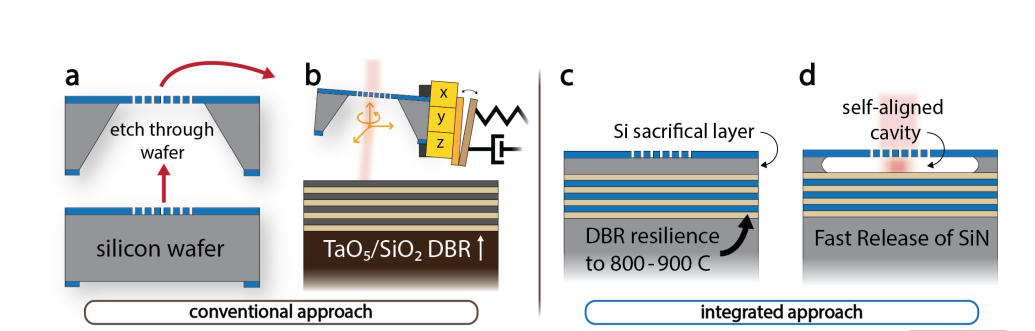
Monolithic Integration of Si₃N₄ and DBR: The main contribution of this work is the development of a monolithic, wafer-level integration strategy that directly suspends high-stress Si₃N₄ membranes above thermally compatible Si₃N₄/SiO₂ DBRs. This integration allows for self-aligned cavities with sub-micron gaps, eliminating the need for delicate bonding or manual alignment. The use of a defect-free amorphous-silicon sacrificial layer and plasma undercut techniques ensures that the cavities are precisely formed.
Design of the Optomechanical Cavity: The optical cavity is formed by coupling a suspended Si₃N₄ photonic crystal (PtC) membrane with a DBR. The design is optimized for high reflectivity and low mechanical dissipation. The membrane’s structure can be tuned lithographically, and finite-element simulations are used to fine-tune its geometry for optimal reflectivity and performance.
Fabrication Process: The paper outlines a dry-processing fabrication flow using low-pressure chemical vapor deposition (LPCVD) to create the Si₃N₄/SiO₂ DBR stack and the sacrificial silicon layer. The high-stress Si₃N₄ membrane is then patterned using electron-beam lithography and etched with an isotropic SF₆ plasma undercut process. This avoids stiction and ensures high yield and uniformity across the wafer.
Optical and Mechanical Characterization: The optical performance of the integrated cavities is evaluated through micro-reflectivity measurements, showing high finesse and tunability of the cavity mode. Mechanical resonance is characterized using laser Doppler vibrometry (LDV), with the mechanical quality factor (Qmech) showing values consistent with high-performance Si₃N₄ resonators, even with the DBR integration.
Conclusion and Outlook: The integration of high-stress Si₃N₄ membranes with DBRs provides a scalable, CMOS-compatible platform for cavity optomechanics. The process is robust, eliminating the need for complex bonding and alignment steps while maintaining high optical and mechanical performance. The platform is well-suited for high-Q nanomechanical architectures, precision sensing, and quantum technologies.
This work represents a significant advancement in the fabrication of compact, high-coherence optomechanical systems, enabling further developments in quantum photonics and precision measurement.
OMeda (Shanghai Omedasemi Co.,Ltd) was founded in 2021 by 3 doctors with more than 10 years of experience in nanpfabrication. It currently has 15 employees and has rich experience in nanofabrication (coating, lithography, etching, two-photon printing, bonding) and other processes. We support nanofabrication of 4/6/8-inch wafers.
