
The paper you uploaded discusses the generation of frequency via four-wave mixing (FWM) in Barium Titanate-on-Insulator (BTO-on-insulator) microring resonators. Here's a summary of the key points:
Introduction: The paper highlights the potential of thin-film Barium Titanate (BTO) for integrated photonics due to its strong nonlinear optical properties, specifically its Pockels and Kerr effects. While much attention has been given to BTO for electro-optic applications (e.g., modulators), there is less research on its Kerr nonlinearity for photonic applications, which this paper addresses.
Nonlinear Properties of BTO: The authors measure the nonlinear refractive index n2 of BTO thin film by using frequency generation through FWM in BTO microring resonators. The determined value of n2=1.4×10⁻¹⁸m2/W aligns closely with previous studies and is found to be one order of magnitude larger than the nonlinear index in thin-film lithium niobate (TFLN), and comparable to silicon, but without the losses caused by free carrier absorption present in silicon.
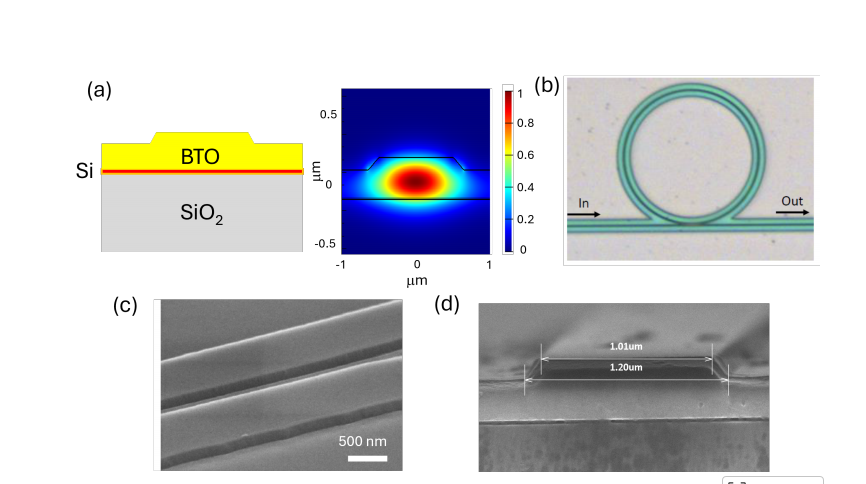
Microring Resonator Fabrication: The paper details the fabrication of BTO microring resonators on a BTO-on-insulator platform. The resonators were designed for single TE-mode operation at 1550 nm and fabricated with a rib waveguide structure that helps to confine light in the BTO core for maximizing nonlinear effects. The devices were patterned using electron beam lithography and etched using Ar gas in an ICP-RIE chamber.
Characterization and Resonance: The resonance properties of the microrings were characterized by measuring their transmission spectra. The results show resonance peaks around 1550 nm, with a free spectral range of 2.682 nm. The resonance curves for different coupling gaps (300–800 nm) were fitted to determine loss and coupling coefficients. The best performance in terms of resonance was achieved for a coupling gap of 500 nm, which showed high extinction ratios and optimal coupling efficiency.
Four-Wave Mixing Experiment: The authors performed the FWM experiment by using two tunable laser sources to generate pump and signal waves at different wavelengths. The pump wavelength was tuned to coincide with the microring resonance, and the signal wavelength was adjusted to nearby resonances. The generated idler waves were observed at the sidebands. The results show that the idler power increases when the signal is in resonance with the microring, demonstrating FWM within the resonator. The resonance enhancement provided a 7 dB increase in idler power compared to the straight waveguide.
Nonlinear Coefficient Extraction: The nonlinear coefficient γ=11.6m/W was determined by fitting the FWM data with theoretical models. Using this value, the nonlinear refractive index n2=1.4×10⁻¹⁸m2/W was calculated, confirming the strong Kerr nonlinearity of BTO.
Conclusion: The paper concludes that BTO-on-insulator waveguides, especially in microring resonators, are highly effective for nonlinear optical applications. The strong Kerr effect, low loss, and large nonlinear refractive index make BTO an excellent material for integrated photonics, including quantum applications like photon pair generation, frequency combs, and squeezed light.
This study demonstrates the potential of BTO as a powerful material for nonlinear photonic applications and sets the stage for future developments in quantum and integrated photonics.
