
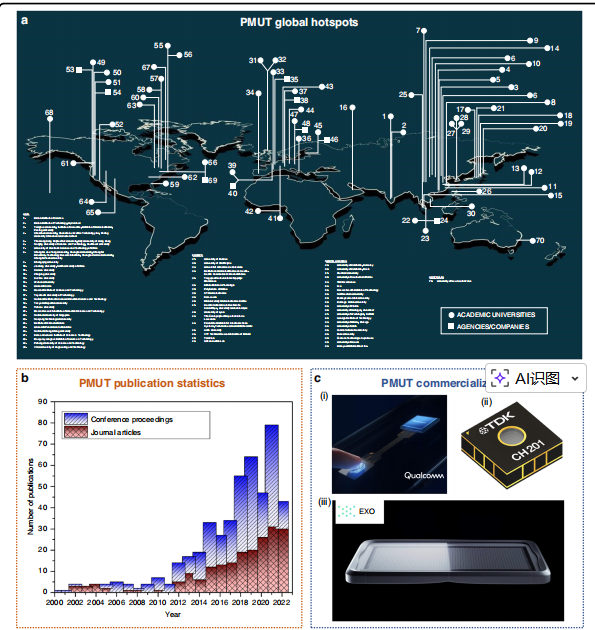
This review article provides a comprehensive look at the development of Thin-Film Piezoelectric Micromachined Ultrasonic Transducers (PMUTs) over the past 40 years. It traces the evolution of PMUTs from the early 1970s, when thin-film piezoelectric materials such as Zinc Oxide (ZnO) and Lead Zirconate Titanate (PZT) were first explored, to their current use in a variety of applications including biomedical imaging, energy harvesting, and consumer electronics.
Key points from the review include:
Historical Evolution: PMUTs have advanced through different stages, beginning with early work on ZnO and PZT thin films, followed by the development of more sophisticated materials like Aluminum Nitride (AlN) and Scandium-doped AlN, which enhance PMUT performance.
Applications: PMUTs are widely used in fields such as photoacoustic imaging, in-body ultrasound, and even for consumer devices like fingerprint sensors. They are also being applied in neuromodulation, energy harvesting, and wearable sensors.
Material Developments: New piezoelectric materials continue to emerge, with a focus on improving efficiency, flexibility, and compatibility with CMOS technology. Materials like ScAlN and PZT fibered epitaxial films are particularly promising for next-generation PMUTs.
Fabrication Methods: The review outlines the two main fabrication processes for PMUTs: bulk micromachining and surface micromachining. It also explores the development of flexible PMUT arrays, which offer significant potential for wearable and implantable applications.
Special PMUT Designs: Several advanced designs have been explored to enhance PMUT performance. These include bimorph PMUTs, curved structures, and arrays with venting rings to improve transmit sensitivity and sound pressure levels.
Global Research and Commercialization: The review highlights the global spread of PMUT research, with active research centers and companies in Asia, Europe, North America, and Australia. Companies like Qualcomm, TDK, and Exo have successfully commercialized PMUTs, with applications in fingerprint sensors and rangefinding technologies.
Future Predictions: The review predicts rapid growth in PMUT research and commercialization, with more than 30 new research hotspots expected by 2025. It also foresees significant advances in flexible and transparent PMUT designs and increased investments in the field.
In conclusion, PMUTs are at the forefront of the MEMS ultrasound revolution, showing great promise for both current and emerging technologies, particularly in medical imaging, sensing, and communication. The review offers a holistic understanding of their evolution, design principles, and potential future applications.
OMeda (Shanghai Omedasemi Co.,Ltd) was founded in 2021 by 3 doctors with more than 10 years of experience in nanpfabrication. It currently has 15 employees and has rich experience in nanofabrication (coating, lithography, etching, two-photon printing, bonding) and other processes. We support nanofabrication of 4/6/8-inch wafers.
