
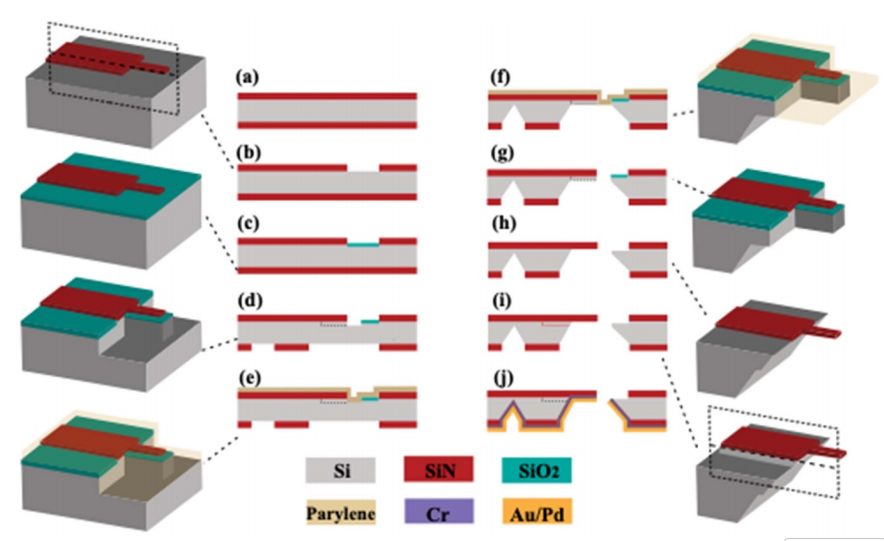
The article discusses the fabrication of ultra-small bimorph cantilevers for high-speed atomic force microscopy (HS-AFM) used for imaging biological samples. The goal of the study is to develop cantilevers that can achieve high resonance frequencies and low spring constants, which are essential for preserving sample integrity while enabling fast imaging.
The paper presents a wafer-scale microfabrication process for producing cantilevers with lengths down to sub-10 µm and resonance frequencies up to 10.5 MHz. It also introduces the use of palladium (Pd) coatings instead of the conventional gold (Au) coatings to enhance photothermal excitation efficiency, thus reducing the laser power required to actuate the cantilevers. The use of Pd improves laser absorption and reduces the thermal load on biological samples, which is crucial for biological applications.
The cantilevers' mechanical properties, including their spring constants and resonance frequencies, are characterized, showing good performance in biological imaging. The paper also demonstrates the cantilevers' ability to image DNA nanostructures, confirming the effectiveness of the fabrication process in real-world applications.
This work contributes to the development of more efficient and scalable cantilever fabrication processes for HS-AFM, paving the way for high-throughput imaging with minimal sample damage.
OMeda (Shanghai Omedasemi Co.,Ltd) was founded in 2021 by 3 doctors with more than 10 years of experience in nanpfabrication. It currently has 15 employees and has rich experience in nanofabrication (coating, lithography, etching, two-photon printing, bonding) and other processes. We support nanofabrication of 4/6/8-inch wafers.
